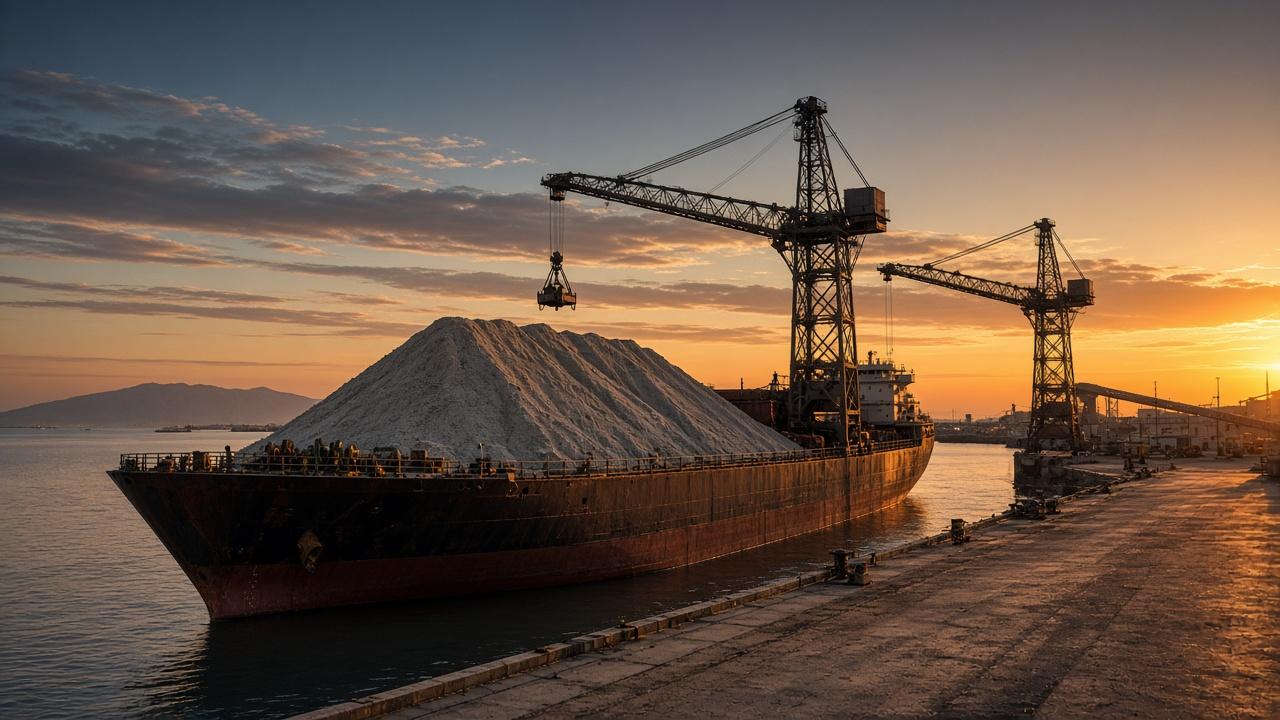
Importing clinker from Algeria into Europe is a sequence. You write the mill's requirement, qualify a lot against it, choose who takes the ship, and agree sampling and documents before anyone calls the stem firm. A price exchanged in the middle of that sequence is a conversation. It is not a cargo. The commercial line is clinker from Algeria. What the specification words mean, including free lime and why two laboratories can disagree, is in what clinker specifications mean. This page is the path: requirement, term, vessel, discharge, papers.
The product is bulk kiln nodules a European mill will grind. In French correspondence the word is the same: clinker. It is not finished cement, and it is not a powder a trader hopes to bag on the quay. You are moving the grinding, and the strength class, into your own plant. That is worth doing when the plant, the store and the berth exist. It is not a simpler way to buy cement.
NAGTAR will structure the path when the brief names a port and a mill sheet. We will not treat a rate, a laycan or a chemical line as firm before the lot and the discharge are qualified. Indicative is a useful word. Firm is a narrower one.
What you decide here
- The mill sheet that accepts or rejects the cargo, with methods where you have them.
- Tonnes per voyage, the discharge port, and whether the store can take that ship.
- FOB, CFR or CIF, including who insures if the term is not CIF.
- Where the sample is taken, and which result governs.
Send the berth limits with the first trade inquiry. "CIF Europe" is a freight average, and there is not an honest one. Name the port.
The berth is the brief
Europe is not a berth. A Mediterranean grinding plant with its own quay and a conveyor into a covered store is one import. An Atlantic commercial quay that trucks nodules inland to a mill is another. Both can be real. They are not the same ship, the same rate or the same laytime. A file that says "clinker for Europe" cannot be qualified, because nobody can check draft, gear or ullage against a continent.
The buyer on this route is a cement producer, or a trader with a producer behind the inquiry. Someone has to be the consignee, clear the cargo, and pay under a structure that works with Algerian export formalities. A desk that wants a CIF idea, with no legal entity and no discharge port, can still talk. It cannot fix a ship.
What the mill is actually short of
Grinding plants without a kiln import nodules, store them, add gypsum, and sell cement locally. Integrated works import when a kiln is down, or when a short campaign is easier to buy than to burn. A few terminals import because they can hold nodules and feed several mills. In every honest case there is covered storage and a mill inside a transport leg the buyer has already costed.
The misfits look like logistics and are really product choice. A job site, a ready-mix plant with silos for powder only, or a bagging line that expected cement cannot receive a hold of nodules and call the problem solved. Those buyers can receive cement. A brief that is really slag or pozzolan for a blend should be named as slag or pozzolan. Those materials discharge differently and are specified differently. Do not hide them inside a clinker nomination.
A buyer whose customers will not wait for a mill trial, because they need the strength class already on a certificate, should buy cement. Importing clinker to avoid a cement specification does not remove the specification. It moves the test to your laboratory after grinding.
Ullage, not the nameplate
Tell us the store's free capacity on the window you want, not the store's design volume. If the shed is full until next quarter, you do not have this stem, even when the annual tonnage looks large. A cargo that does not fit is a ship alongside a full shed. Somebody pays for the wait, and it is rarely the person who wrote "annual programme" on the inquiry.
Sanctions and destination are checked before the ship is named. We screen the counterparty, the vessel and the destination. A route built to hide where the cargo will be ground is a route we decline. Europe, in this note, means a declared European discharge the importer can document.
Who takes the ship
FOB, CFR and CIF divide the same cargo. They do not change the chemistry, and they do not fill in a missing sampling clause. Choose the term because of who should control the ship and the freight. Then write the quality clause anyway.
FOB, when you already charter
FOB means the cargo is delivered loaded on board at the Algerian load port. You arrange the ship, you pay the freight, you insure if you want insurance, and you discharge in Europe. Buyers who already charter, or whose discharge port is awkward, usually prefer this. They would rather choose the ship than inherit one fixed to a guessed berth. You carry the freight market and the cost of a slow discharge.
CFR, when the freight should be in the price
CFR means the freight to the named European port is arranged and paid on the sell side. Marine insurance stays yours. You still discharge. Risk still follows the Incoterms allocation once the cargo is on board, which is why insurance is a decision and not a footnote. CFR is the useful term when you want freight included and you already have a cargo policy, or you prefer your own broker. It is not the term to ask for after you have already chartered.
CIF, when the cover has a name
CIF is CFR plus marine insurance to the cover the contract states. The insurance certificate joins the documents. "Clinker CIF Europe" is what people say when they have not yet named the port, the cover or the deductibles. We do not sell an unnamed European average and call it CIF. Name the port first. Then the cover is a sentence, not a slogan.
Whichever term you choose, discharge at the plant stays a physical job on the buyer's side of the quay unless a different term was actually agreed. The Incoterm is not a stevedore. A CIF contract with no sampling clause is a freight and insurance contract that happens to mention clinker.
What the grab meets at the European quay
Picture the ship alongside. Shore cranes, or the ship's own gear, put a grab into the hold. The grab dumps into a hopper. If the store is on the quay, a conveyor takes the nodules under cover. If it is not, trucks do, and every cycle adds time, fines and a queue at the shed. The last tonnes in the corners are slower than the first hour. A discharge rate copied from a grain berth will not survive clinker and a small hopper. The rate in the charter party has to be the rate that operation sustains.
Send the limits you already know: draft on the berth you will actually get, length, whether shore cranes exist or the ship must carry gear, and whether grabs and an open hopper are acceptable. A vessel fixed to a guessed European berth is how a ship arrives and waits. Laytime and notice of readiness depend on the berth being reachable and on the ship being ready to discharge. If the berth is occupied by another raw material, or the store has no ullage, the ship waits. That fact belongs in the first email, not in the statement of facts.
Dust, rain and weight
Dust and rain are the two interruptions European ports actually argue about. Wind takes fines off an open grab and the port stops the job. A covered hopper and a sensible grab technique are operational, and some ports will require them. Rain means hatches closed and the clock treated as the charter party says. Read the weather clause before you sign it.
At the plant, nodules go under cover. An open pad is where moisture, caking and a drifting free-lime result begin. Weight is normally a draft survey. Water in the hold increases that weight and does not increase the dry clinker the mill can grind. If rain during loading or on the voyage is the claim you fear, say so when you place the sampling points. Do not discover it when the draft survey and the mill's dry tonnes refuse to match.
The pack is the hold. Bulk nodules are the normal import. Bags and containers are an exception, and only when the receiver can justify them. A European grinding plant almost never wants to cut clinker bags. If someone offers bagged clinker into a mill, ask who empties them and why the hold was not available.
We do not publish a standard parcel size. The shipment is whatever the two ports, the ship and the shed can take together. An annual tonnage asks us to invent a stem. Send the tonnes per voyage.
Sampling before anyone is angry
On an import, the specification is the acceptance rule at the sampling point you chose. The language is the mill's: free lime, oxides or a named phase calculation, loss on ignition, moisture, and alkali or chloride if the cement you will sell requires them. A limit with no method is a future argument between two laboratories. Agree the convention before loading, not in a claim. The companion note on specifications is where that argument is unpacked. This page only insists that the method travels with the limit.
The usual mill pattern is a load-port inspection. Holds are inspected. Increments are taken as the cargo loads. A composite is split for the buyer's laboratory, with a retain. Add a discharge sample if the claim you fear is rain, seawater or a dirty previous cargo. Say which result governs. Name an umpire laboratory while everyone is still polite. A certificate that omits the parameter you will accept or reject on is not the certificate for this import. A sample scraped from a truck after the cargo has already been stacked in the rain answers a different question. It will not match the bill of lading weight or the free-lime method you agreed.
What is not a national figure
NAGTAR does not publish a standing assay for Algerian clinker. Results are confirmed on the qualified lot. A previous cargo's certificate can show a format. It is not the cargo you are about to fix. If the lot does not yet have results, the offer stays indicative on quality even when the freight idea is taking shape. We will not invent a line to complete a proforma.
Importers also ask for things that are not chemistry and still belong in the file. Nodule size, if the reclaim system plugs. A statement that the cargo is kiln clinker and not a blend with slag or pozzolan. Hold cleanliness. Moisture after rain. None of these needs a fabricated number on a website. They need a sentence in the contract and a person who will look.
Grindability is the request that arrives too early. A European mill's tonnes per hour belong to that mill. An index from somewhere else is a clue, not a promise. If you need a trial, plan it on the qualified lot or in your own mill. Do not let the trial become a reason to print a national figure.
Papers the mill and the broker both touch
European importers usually collect a commercial invoice, a bill of lading, a weight document from the draft survey or another agreed method, a certificate of origin, and the quality certificate. The inspection certificate joins them when a company was appointed. The insurance certificate joins them on CIF. Packing lists are for bagged goods. Bulk clinker is weighed, not counted in sacks.
Brokers often ask whether a preference or origin form is available for the customs regime at destination. That depends on the country and the regime for that shipment. Ask before loading, so the exporter's bank and customs file can support it. We will not promise the duty outcome. Your broker advises on the entry. We advise on what Algeria can issue for the qualified shipment.
Payment has to work with Algerian export practice. Export proceeds go through a bank domiciliation file, so the instrument and the timing are discussed with the term, not after the ship is fixed. If your treasury can only pay in a shape that file cannot accept, say so in the first week. A perfect freight idea with an impossible payment is not an advanced file. It is a file that will reopen.
Where the path actually stops
Qualification follows the sequence on supply and export: requirement, a real lot, a commercial frame, inspection and documents, then loading. Each gate can stop the file. That is the point of a gate.
The mill sheet is matched to a supply path. Kilns are named when the file is live and the information is yours to have. They are not a public capacity list, and there is no national tonnage to quote. Chemistry stays indicative until results exist for the lot that would load. If the results miss the sheet, the file stops or the lot changes. Your ceilings are not rewritten to fit a cargo, and the cargo is not described as if it had passed.
What slows a deal after the price looks agreed is usually ordinary. The specification arrives as a cement standard pasted onto clinker. The discharge port is a country, with no berth limits. The store capacity is an annual number. The buyer wants CIF and also wants to name the ship. Inspection is requested after the laycan is already tight. Payment terms appear in the last email and conflict with domiciliation. The destination changes after documents have been drafted. Two laboratories discover they do not share a method for free lime. None of this is exotic. All of it costs days, and some of it costs the stem.
What we will not call firm: a price without a port and a term, a laycan without a lot and a berth, a chemical line without a lot and a method, a customs preference that has not been checked, a vessel that has not been screened. If a sanctions screen is unclear, we decline rather than route around it. An indicative offer that lists its open items is a real document. A firm offer that hides them is not.
Send the discharge with the tonnes
Use the trade inquiry. English is enough. The price conversation should happen once, against a cargo that could actually load.
- Mill sheet, with methods where you know them, and the items that accept or reject.
- Tonnes per shipment, not only tonnes per year.
- Discharge port, draft, length, gear or shore cranes, and whether the store is on the quay.
- Free capacity on the window, not the shed's nameplate.
- The Incoterm you want to discuss, and who insures if it is not CIF.
- Load-port sample, discharge sample, or both, and which result governs. Name the inspection company if you have one.
- Whether this cargo is being compared with buying cement, and whether a later shipment would repeat.
A programme is several lots. It is not one certificate reused.
Questions that stall the file
What does FOB change compared with CFR or CIF?
FOB puts the ship, the freight and the insurance decision on you, after the cargo is on board in Algeria. CFR pays the freight to the named port, and you still insure and still discharge. CIF adds insurance to an agreed cover, with the certificate in the document set. None of the three sets free lime, the sampling point or the discharge rate. "CIF Europe" without a port is an unfinished sentence.
Which documents does a European importer usually collect?
Invoice, bill of lading, weight document, certificate of origin, and a quality certificate that reports the contract parameters by the named methods. Add the inspection certificate if you appointed a surveyor, and the insurance certificate on CIF. Ask your broker, before loading, whether the entry needs a specific origin form. We confirm what can be issued from the Algerian side. We do not certify your duty position.
Why do clinker imports stall after the price looks agreed?
Because the price was the only closed item. The berth limits arrive late. The store is fuller than the annual plan suggested. Free lime has a ceiling and no method. The buyer wants CFR but has already chartered. Payment does not fit export domiciliation. Send the discharge description and the acceptance rule with the first inquiry.
What will you not call a firm offer?
A number with no lot, no port, no term and no sampling point. A laycan that is only a month named in an email. A chemical result copied from another cargo or from a cement certificate. A promise that every European port can discharge the same ship at the same rate. Firm means the lot, the sheet, the Incoterm, a shipment the shed can take, and a vessel and destination that pass screening.
Does the grinding plant need to be on the water?
It needs a discharge it can sustain. Some mills have the berth at the gate. Others take trucks or rail from a commercial quay, and that leg belongs in the time and the cost before you compare FOB with CIF. If there is no covered store, no ullage, and no gear or shore crane, the plant is not ready for this import. A ship does not create a shed.
Where should the sample be taken?
Where the risk you care about happens. Load-port sampling describes what was put on board and is the right governing sample for kiln chemistry if the holds were sound. Discharge sampling describes what arrived, which matters for rain, seawater or a dirty previous cargo. Many mills want both, and a written rule for which one accepts or rejects. Name the umpire with the rule.