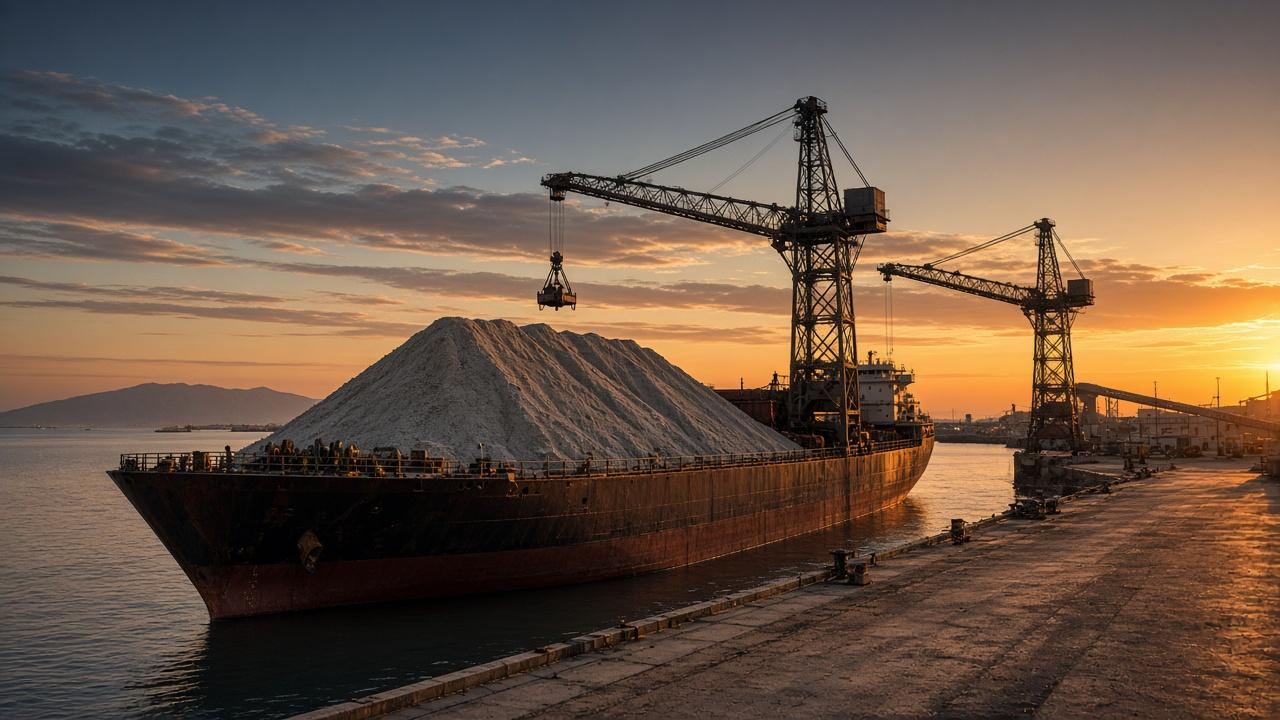
A cement mill that writes GBFS, GGBS or GGBFS is almost always asking for one product: ground granulated blast-furnace slag. The letters move around. The solid does not. It is slag from an iron blast furnace, quenched so that a large part of it stays glassy, then ground to a fineness the finish mill can dose. Coarser slag that has been granulated and not ground, or slag that was cooled in air and crushed as rock, can share the furnace and still be the wrong cargo.
Mills buy the ground form to replace part of the clinker in a cement they already know how to sell. The replacement is partial. It sits inside a cement standard, a strength curve and a silo the plant already runs. Fineness, glass content and activity decide whether that replacement is real. They are questions we put on the qualified lot. They are not figures this desk prints in advance.
If the email only says "send slag", we stop and ask which form. This note is the distinction we use before an Algerian lot is offered as GBFS.
What buyers mean when they say GBFS, GGBS or GGBFS
In the inquiries we receive, GBFS is read as ground granulated blast-furnace slag. Some desks expand the same letters as granulated blast-furnace slag and only add "ground" on the next line. GGBS and GGBFS are the longer forms. The extra G stands for ground. The F, when it appears, stands for furnace. We treat all three as one request unless the attached size shows the buyer wants the unground granule. The abbreviation is a shorthand, not a specification.
The unground granule is still blast-furnace slag. Molten slag quenched with water comes out sand-like or gravel-like. A mill can grind it. Many mills would rather buy it already ground, because the finish mill is committed to clinker and gypsum. Other mills have a slag mill and want the granule. Both requests are legitimate. They are not the same bill of lading. An offer that says "ground or unground, same basis" is an offer of two products.
French-speaking buyers sometimes write laitier and expect the form to be obvious. In a cement sentence, laitier granulé points at the granulated product rather than at air-cooled lump. It still does not say whether the granule is to be shipped as-is or after grinding. We ask.
Air-cooled blast-furnace slag is crushed rock from slag that was allowed to crystallise. Aggregate buyers take it on a grading. A cement blend wants the glass, because the glass is what later reacts with the clinker and the sulfate. Grey rock and a GGBS line do not belong in the same quotation.
Fly ash, limestone filler and natural pozzolan can sit next to clinker. None of them is blast-furnace slag. Pozzolan is a siliceous material, usually natural on the Algerian lines we discuss, and it is qualified on its own brief. Shipping it against a GGBS request fails at the silo.
The decision a mill is actually making
The decision is how much clinker the mill can take out of a given cement and still meet the standard, the setting and the strength its customers already buy.
Clinker is the sintered nodule from the kiln, the main hydraulic part of ordinary Portland cement. A qualified slag in the finish mill lowers the clinker factor of that cement. The cut is a percentage the quality manager will sign, inside a cement type the plant can still sell. Slag-rich cements, including types in the CEM III family, exist for that reason. A plant that only sells a CEM I with a high clinker minimum cannot use the same rate, however good the sample looks.
The second decision is who grinds. If the buyer grinds, the cargo is the granule. Moisture in that granule is part of the mass delivered, and the buyer's separator sets the fineness. If the buyer wants powder, fineness is a contract parameter and the grinding was done before loading. We do not leave that choice open in the recap.
The third decision is whether slag is the right addition. Some plants are built around pozzolan or limestone. Some can take only a modest slag rate because of colour, early strength or setting. We ask which cement they are making. If the gap is clinker, the file moves to clinker. If the gap is a natural pozzolan, it leaves the slag desk. If the gap is ground granulated blast-furnace slag, we fix the form before we look for a lot. How to write the blend brief, including moisture and stowage, is in blast-furnace slag for cement blending.
Specifications that stay on the lot
We do not publish a glass content, a Blaine figure, a sieve residue or an activity index for "Algerian GBFS". Those results move with the furnace burden, the quench, the grinding and the lab method. A number on a website becomes a claim. If the lot in front of us does not match it, the claim was false. The specification is built from the inquiry, then checked on the qualified lot.
Fineness is the first question on a ground product. Mills speak in Blaine, in residue on a named sieve, or in a laser curve. Those are not the same measurement. A Blaine target with no method, and no word on whether the figure is a minimum, can pass on a sheet and fail at the separator. We ask which method the receiving laboratory uses. For an unground granule we ask for the size range and for a limit on lumps and dust, in the mill's words.
Glass content is the second question, and it stays a question. The glassy fraction is what makes granulated slag latent-hydraulic. Crystallised slag does not do the same work beside clinker. Glass can be estimated by microscopy or by another method the lab names. We ask whether the buyer has a minimum, which method they accept, and whether a miss is a rejection or a conversation. We do not type a glass percentage into an offer to make the page look finished.
Activity is the third question. A strength activity index, or the test the cement standard names, is measured on mortars at defined ages against a reference cement. Early age and 28-day behaviour can diverge. A slag that looks acceptable at 28 days can still upset a mill whose customers buy on two-day strength. We ask which ages matter. The index is a result on the lot, after a laboratory the contract names has run the test.
Chemistry sits beside those three, still without a published window. Buyers often ask for CaO, SiO2, Al2O3, MgO and sulfide, sometimes chloride or alkali. The limits belong to the buyer or to the standard they cited. Magnesia that is fine in one blend is a problem in another. We record the limits and match them to analyses from the lot, not to a generic slag sheet.
Moisture and, where stowage needs it, bulk density come from the same qualification. A dry laboratory sample and a stockpile that has taken rain are not the same material.
We will not fill blanks. If the brief says "standard GGBS" and names no standard, we ask which document the receiving lab will open. EN 197-1 governs cements. It is not, by itself, a slag certificate. The buyer points at the document. We then see whether the lot can be offered against it.
Uses, and the product that does not belong in the mill
The use in this note is cement. Ground granulated blast-furnace slag goes into the finish mill, or into a blender, with clinker and with the sulfate source the plant already uses, usually gypsum. The slag is not a finished cement. A ship of GGBS does not discharge as a CEM III. The mill still grinds or blends, still controls sulfate, and still tests the cement it puts its name on.
Inside that use the jobs differ. One mill wants a modest clinker replacement and watches early strength and colour. Another makes a slag-rich cement for marine or mass concrete and watches later strength and heat. A grinding station with no kiln buys clinker and slag as the two feeds that make the business. The ratios are not the same. We do not propose one replacement rate for all three.
Some concrete plants buy ground slag for the batching plant rather than for the cement mill. That use still needs a fineness and an activity the concrete specification accepts. It is not a reason to send unground granule to a plant with no mill.
Road base and armour stone want air-cooled slag, graded as aggregate. A cement mill does not turn that rock into a glassy binder by grinding harder. Soil uses that sometimes take slag fines follow different contaminant rules. They do not ride inside a cement offer.
Natural pozzolan can replace part of the clinker in plants set up for it. It is not slag, and a mill that has qualified a slag cement will not accept pozzolan under the slag name. Limestone filler and fly ash are further additions. If the standard allows several, the shipment still names one. "SCM" on an email is a category, not a hold. Clinker is the wrong cargo when the mill asked for slag, and slag is the wrong cargo when the only gap is clinker. A buyer who needs both sends two specifications.
Packing and cargo
Most of the volume moves as bulk on a dry-bulk ship. Ground slag is a powder. It dusts at the grab or the loader, and rain is not a minor inconvenience. Unground granulated slag is more at home under a grab, but the granule holds moisture in its pores. That moisture is weight. On a wet basis, with no clause for what happens above an agreed moisture, the buyer can pay for water. On a dry basis, the moisture sampling method is written before loading, not after the draft figures arrive.
Stowage is agreed per shipment. Powder and granule do not fill a hold the same way, and moisture moves the figure. We do not keep one stowage factor for "slag". The ship, the load port and the receiver's gear decide grab, spout or silo trucks. A powder on a grab-only ship, with open holds and rain forecast, is a problem for the recap, not for the berth.
Bags and big bags cover a trial or a plant that cannot take bulk. A big-bag result does not automatically become a bulk hold. The bag may have been dried or ground for the sample. The bulk lot is qualified again.
A hold that last carried chloride, sugar or a dusty alkali can spoil a slag that was fine on the stockpile. We ask for the previous cargo. Clinker and slag can share a programme. They should not share a hold unless the receiver has agreed a combined discharge. The two products head for different silos, and a mix at the grab is expensive to undo. Load port, rate and laycan go in the recap before the buyer nominates tonnage. We do not promise a berth in a general note.
Documents, inspection and Incoterms
The papers follow the destination and the cement standard in the contract. A working file has a commercial invoice, a packing list where packing exists, a bill of lading, a certificate of origin when customs or the buyer asks, and a quality certificate on the lot that was loaded. That certificate is useful only if it reports the tests the contract listed: fineness by the agreed method, the chemistry named, moisture, and activity or glass where those were conditions.
Some buyers want an independent sampler at loading and a sealed split for the receiver. Some accept the producer's laboratory, with a referee if the discharge sample disagrees. We coordinate independent sampling when the buyer or the standard requires it. A photograph of the stockpile is not an inspection.
The usual dispute is the gap between a sample taken weeks earlier and the material that entered the hold. The earlier sample decides whether the lot is worth pursuing. The certificate on the ship should describe what was loaded, under the sampling rule in the contract. If the two diverge, the contract should already say whether the buyer can reject, claim, or only adjust the next shipment.
Incoterms decide who books the ship and when risk passes. They do not decide what the slag is. Under FOB the buyer nominates the vessel. CFR and CIF put the sea freight with the seller, and CIF adds insurance. The Incoterm does not replace a moisture clause, a sampling clause, or a line on whether weight is by draft survey or by belt scale.
How Algerian supply is qualified
NAGTAR works from Algeria with selected industrial partners. A blast furnace, a granulator and a grinding plant are specific works, with campaigns and stockpiles that change. Naming them here would freeze a picture the next inquiry might not find. Qualification is a file on a lot.
The file starts from the buyer's form and limits. We ask whether that form exists in the window named, in a volume that justifies the ship, and with a laboratory that can run the tests the contract will cite. If what is available is coarser than the brief, we do not rename it as GGBS. We either find grinding that can hit the fineness, or we tell the buyer which form exists and let the mill decide.
A laboratory sample is a screen, not the cargo. It can be drier than the stockpile edge. If it fails the limits, the lot stops. If it passes, we still agree how the loaded cargo will be sampled. Glass, fineness and activity, where the brief requires them, are confirmed on that lot by the method both sides accepted. A short sheet from the lot, with the method on it, is the document we will stand behind. A smooth range that no furnace has promised is not.
If the commercial story and the works that made the slag differ, we do not cover the gap with an "Algerian GBFS" label. The buyer is blending this into a cement that will carry their name. A trial of a few hundred tonnes and a parcel that fills a hold are different qualifications. We do not scale a trial certificate up and call it the same lot.
What to send with the inquiry
The first message can be short. Send it on the GBFS and blast-furnace slag line, with the points below. We can start from less. Every missing line becomes a question, and the questions are what delay a sample.
- The form in words: ground granulated blast-furnace slag, or unground granulated slag, or another form you actually want. Use GBFS, GGBS or GGBFS only as a shorthand for the ground product.
- The cement you make, or the standard you sell to, and the clinker replacement you have in mind. A range is enough.
- Fineness or size, with the method. If you have no number yet, name the method your lab will use.
- Any limits you already enforce on chemistry, glass content and activity, with the test methods. If you have no limits yet, say so.
- Volume, spot or monthly, and whether this is a trial or a hold.
- Packing: bulk, or a bag format and the reason.
- Destination port, and the discharge limit that binds you: silo, grab, rain cover, truck rate.
- Preferred Incoterm, and whether weight is draft survey or scale.
- The inspection you will require, or a clear statement that the producer's certificate is enough for the first look.
- When the mill can take the cargo, and when a sample has to be in the laboratory if the result is to matter.
A target price can wait until the form and the lot are the same thing. A price on the word "slag" is a price on an undefined solid. If you also need clinker, put that specification in the same message as a separate block. If you are still choosing between slag and pozzolan, say so. We would rather split the file than qualify the wrong powder.
Is GGBS the same product as GBFS?
In the way cement buyers write to us, yes. GGBS, GGBFS and GBFS are names for ground granulated blast-furnace slag. The risk is not the extra letter. The risk is a supplier who reads GBFS as unground granule and ships that. If the plant needs powder, write "ground" in the sentence, state the fineness method, and keep the abbreviation as a label rather than as the whole specification.
Can a mill use unground slag instead of clinker?
Only if the mill will grind it, and only if the slag is the granulated, glassy form rather than air-cooled rock. The granule is a feed. It is not something to tip into a silo of finished cement, and it does not replace clinker nodule for nodule without a formula the quality manager has accepted. If you want the grinding done before shipment, ask for the ground product and put fineness in the contract. If you will grind, ask for the granule and put moisture, size and glass on the brief. The two offers stay separate.
Is pozzolan a kind of slag?
No. Pozzolan is a different material. In the supply we discuss it is usually a natural siliceous product, qualified on a pozzolan brief, not on a slag brief. It can also replace part of the clinker, which is why the two get mixed up in conversation. The chemistry, the activity test and the way the mill doses it are not the slag tests. If your standard allows either, pick one for the shipment. A hold does not carry a category.
Do you publish glass content or an activity index?
No. Glass content, activity and fineness are confirmed on the qualified lot, by methods the contract accepts. A published index would describe a product we have not sampled. Ask for the result on the lot you are being offered, and set it against the limit your cement standard and your customers require. If a test you treat as mandatory has not been run, that absence is part of the answer. We will not fill it with a typical value.
What is the difference between this and buying clinker?
Clinker is the kiln product that forms the hydraulic core of the cement. Ground granulated blast-furnace slag is a constituent used so the cement contains less clinker, inside a standard that allows the blend. Grinding stations often buy both. They are two cargoes and usually two holds. Start from clinker when the gap is the kiln product, and from the slag page when the gap is the addition.
Which documents should a first slag offer include?
For a first look, a quality note on the proposed lot matters more than a full shipping file. It should state the form, the fineness or size method, the chemistry that was run, moisture, and activity or glass only if those tests were done. Invoice, bill of lading and insurance follow once an Incoterm and a ship exist. A certificate with no method, or one that describes a different form, is not a document to approve.