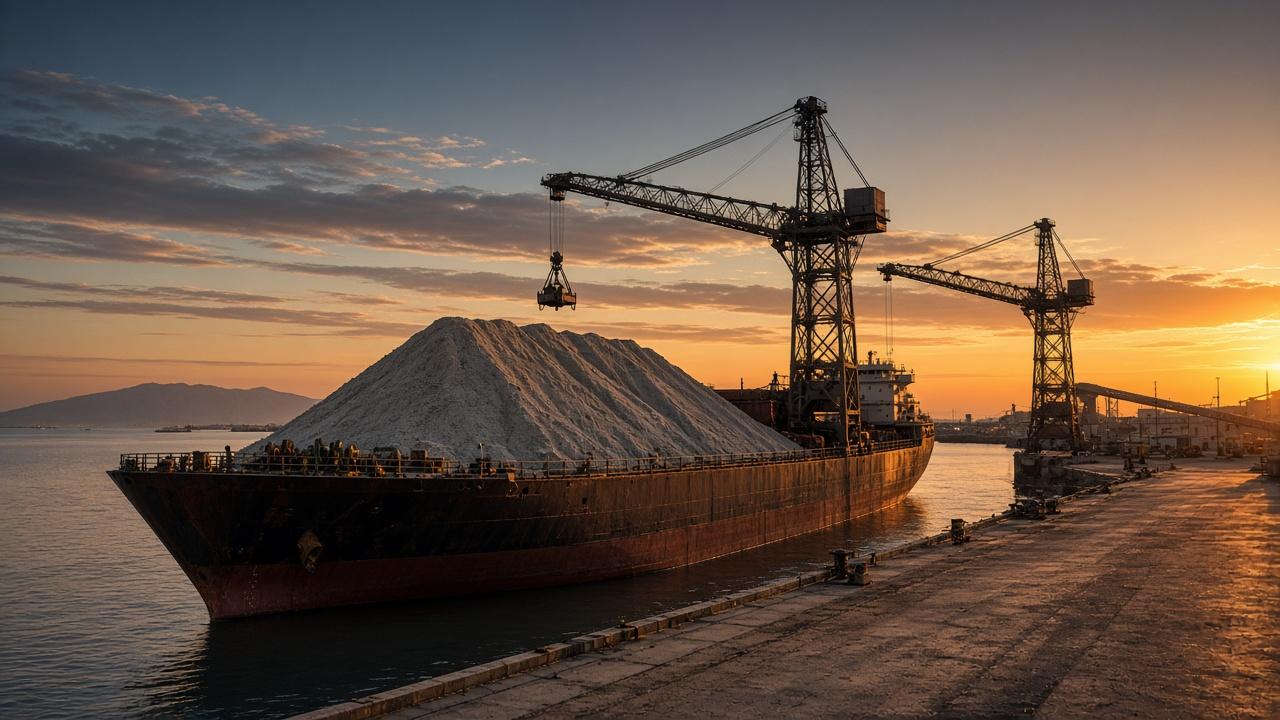
A clinker specification is the mill's rule for whether this lot of nodules may be ground. Free lime, the oxide chemistry, and the phase language that plant already uses are that rule. They apply to one cargo. They do not score a country, and they are not the strength class on a bag of finished cement. The line is clinker from Algeria. If you need a powder with a type and a strength class, open cement. Ship, berth, the choice among FOB, CFR and CIF, and bank domiciliation are in how to import clinker from Algeria. This note stays on the chemist's accept or reject.
Clinker is what leaves the kiln after the raw meal sinters and cools: hard, irregular nodules, dark to grey, plus the dust handling makes. The finish mill grinds them, usually with a sulphate source and often with limestone, slag or pozzolan. Cement is the powder after that grind. The specification stops at the nodules, on a named lot. In French the trade uses the same word, clinker. The buyer of nodules still owns the grind, the sulphate dose and the cement standard downstream customers enforce.
Raw mix, fuel, burn and cooling move from one kiln run to the next. A workable sheet is short: oxides, sometimes a calculated phase split, free lime, loss on ignition, moisture, and how the nodules behave in the reclaim. Each figure is a result on a lot. NAGTAR does not publish a standing assay. Chemistry is confirmed on the qualified lot, or quality on the file stays indicative. A yearly tonnage is not chemistry. Typical oxides with no lot, no date and no sampling point do not describe a hold.
What you decide here
- Free lime, with the oxides and any phase language the mill will accept or reject on.
- The method that has to travel with each limit, so two laboratories run the same test.
- Whether the file is still clinker, or has become cement, slag or pozzolan under another name.
- The sampling point the certificate must describe, and which result governs if two samples disagree.
Send the mill sheet, methods beside the limits, through the trade inquiry. Do not ask for a published national analysis. A lot cannot be qualified against a country.
Free lime is where the argument starts
Free lime is calcium oxide the kiln did not combine. The risk shows after grinding, in the paste, as slow hydration and expansion. The ceiling is the mill's, on this lot, by the method the contract names. Miss it and the offer stops or the lot changes. A figure called typical of supply from Algeria describes no hold you can nominate.
A limit that forgot its method
This is where claims start. Solvent, temperature, contact time, the titration and the basis, as received or dried, are part of the number. Change one of them and two careful laboratories can disagree by enough to cross a ceiling the previous cargo cleared. A clause that says only free lime, maximum, and leaves the method to whoever holds the jar, is two deals wearing one word.
Write the method your laboratory already runs. If there is no house method, agree it before loading. The limit is the test, so the reference, the basis and what a miss means sit on the same line as the ceiling. Do not let a broker fill the blank from a cement standard or from the last seller's procedure. Both sides repeat the work on a split of one composite. If one laboratory dries the sample and the other does not, you have compared two preparations.
Crushing is part of the same line. Nodules are reduced to the size the procedure names before any solvent is added. A jaw set too tight, or a laboratory grind that runs hot, changes what the titration sees. Two laboratories that crush to different fineness have already asked different questions.
The pile is not one sample
A crust on an aged stockpile is not fresh discharge from the cooler. A face that took rain is not the centre of the pile. Loss on ignition follows that history: leftover moisture, early hydration, carbonation, and how hard the burn was. The certificate has to name where the sample was taken, and the contract has to say whether that place governs.
Wet nodules weigh more and give free lime time to start reacting in the pile. Measure moisture on the sampling plan, and say what you will do if the lot arrives wet. An open stretch between ship and shed is enough for a load-port number to stop describing the jar at the reclaim. Averaging a wet face with a drier account of the same pile is how a miss gets talked into a pass.
Two laboratories and one clause
The oxides are what a mill can check without borrowing another plant's arithmetic. Calcium, silicon, aluminium, iron, and the minors from raw materials and fuel, are the measurements. Many plants then calculate C3S, C2S, C3A and C4AF on a Bogue-type convention, or on a variant they have used for years. That split is not a second analysis under the oxides.
Same oxides, two phase numbers
The same oxide page can come back as two phase splits. The inputs agree. The convention does not. A C3S minimum with no convention named becomes a dispute at the discharge sample, filed as quality when it is arithmetic. Name the convention, including any correction your chemist applies, or name the oxides and let the mill calculate as it already does. A phase number typed into an empty cell, so a proforma looks complete, is not a result.
If the oxides govern, the phases are comment. If the phases govern, the convention governs with them. Close that line before anyone discusses a ship. The import note is where the ship, the berth and the sale term live, and it assumes this line already exists.
Sulphate on the nodule is not sulphate in the cement
Most of the SO3 in cement is the gypsum, or another set regulator, added at the finish mill. A clinker contract does not include that addition. Paste a cement sulphate limit onto nodules and you reject a cargo that was never meant to carry the gypsum. If kiln sulphate matters to the cement you sell, write a ceiling on the nodules and say so.
Alkali, as a sodium oxide equivalent, belongs only where you sell low-alkali cement or where alkali-silica reaction is a real customer line. Chloride belongs only where a standard or a project cap forces it. Name the oxides, the basis and the method. If you do not enforce the line on cement you already sell, leave it off the clinker sheet.
Grindability belongs to the mill
A grindability index is not a fact about the country the kiln sits in, and it is not a national index. It is how one prepared sample broke under one procedure. Hourly tonnes belong to your circuit: charge or rollers, separator, air, sulphate, additions, fineness and feed moisture. An index from another works describes that works. A figure with no machine, no preparation and no lot is a blank.
If you need a number, trial the qualified lot in your mill, or on a laboratory method you will name in the contract as a method, not as tonnes per hour. Ask for the retain when you write the sampling plan. A laboratory mill is not your circuit. Say which machine governs. The next kiln run is another lot.
If you accept or reject on loss on ignition, use the same sampling point as free lime. A cooler figure against a reclaim figure is two places.
A cement standard pasted onto nodules
The file in the wrong product says clinker 42.5, or pastes a cement standard under a heading that still says clinker. A strength class is produced by the mill, the gypsum, the fineness and the additions, and it is tested on powder or mortar. You cannot stamp it on nodules at the loader. If the buyer needs the class already made, the file is cement. Buying nodules moves the test to your laboratory after the grind. That is why a mill buys clinker. It is a poor way to buy cement.
What you are buying is the chance to make cement
Soundness, setting, strength and ordinary grey colour after grinding are checks on cement. The nodule sheet is the gate before the mill. The cement sheet is the gate after it. If you want the second gate already shut, buy cement. If you want gypsum, fineness and additions in your own hands, buy clinker and keep the cement standard for the product you sell.
Grey kiln clinker will not make white cement. If the market is white, say so in the first message and stop. The same stop applies to a setting target that assumes a sulphate system nobody has described. One sentence is enough: who grinds, who adds sulphate, what fineness, which additions. The cement standard does not pass down to the nodules.
When the grey material is an addition
Ground granulated blast-furnace slag and natural pozzolan are blended with clinker or with cement. They are not the kiln product. If the brief is GBFS or pozzolan, write that brief. Chemistry, moisture and sampling differ, and a free-lime ceiling on nodules describes neither. There is no lot that is both the nodule and the slag.
Need both, send two sheets and say which tonnes are which. A clinker certificate does not qualify slag, and a slag certificate does not give the free lime. One ship is not one material. A shed blend with no record of proportions is no longer the certified lot. Bags for a site, or a ready-mix plant with no mill, belong on the cement file unless a grinding line exists and was not mentioned.
Nodules, moisture and a reclaim that plugs
What loads is lumps, smaller pieces and fines, after a cooler, a store, a grab and a transfer. It is not a powder, and it is not a tight size cut unless your reclaim forces one. Oversized nodules stall a feeder. Fines throw dust at the grab and on the belt. Write a size limit only if this plant has blocked before. A catalogue size is a test you may not have defined.
What the feeder sees
Picture the covered store. The pile sits on a feeder, or against a belt that cuts under the toe. Dry, the nodules trickle, the feeder stays full, and the belt to the mill bin runs steady. After rain on an open pad, or a hatch left open, the fines take water and pack. In the hopper throat they bridge. The operator hits the steel. A slug of wet fines drops, then a gap, then another slug. The shift calls it contamination, because a plug feels foreign. It is the same clinker, with water in it.
That is the reclaim that plugs, and moisture is the clause next to it. Wet nodules show more tonnes on a draft survey than the dry tonnes you can grind. Water is not saleable clinker. Silence gives you a weight claim and a quality claim together. Say if the store is covered, and if ship to shed is a conveyor or a truck haul that can wait in weather. Clinker can still be warm at loading. Write a temperature practice if the terminal has one.
Fines are a handling result
Dust is breakage, not a packed grade. If wind stops an open grab, say so in the brief. The last tonnes in a hold carry scrape, and whatever a previous cargo left if the hold was not inspected. A tidy certificate on a dirty hold makes chloride or loss unreadable. Two lots in one shed, with no wall, make every certificate describe a mixture. Accept before you blend, or sample the blend and drop the first certificates.
Bags, when someone asks anyway
The pack is the hold. Bags and containers are the exception, and only where the receiver can say why bulk was impossible. Ask who empties them. Most of those requests are cement. If the sample is already powder, ask what was ground, whether sulphate was added, and which standard it meets. It should not keep a nodule specification because the label still says clinker.
The certificate that can sit beside the clause
A certificate that can sit beside the clause names the lot, the date, the sampling point, the laboratory, and each item by the method the contract named. Set it on the mill sheet. If free lime decides acceptance and the page omits it, the paper is for another contract. Phases the clause never defined are talk. A retain you cannot trace to the same increments is a jar with a story.
On the bench the comparison is physical: the sheet, the certificate, and a sealed retain with enough mass for a retest. A number with no method is a blank that happens to contain digits. Stop there. Do not average the two laboratories into a pass.
Increments, a composite, a retain
Once the cargo is moving, take a load-port survey. Hold condition first, then increments from the falling stream, or from another point both sides accept, at a frequency in tonnes or in time. One increment every stated block goes into one clean container and is reduced at the end. Do not keep the increment that looked best. If the next hatch draws from a different face, keep sampling. The composite is the cargo, or it is not.
Say who reduces it, riffle or another method both sides have used. Scooping fines off the top biases the split toward dust. Fines and lumps are not the same sample. Catch only loader dust and you have described the dust. The method travels with this plan. A careful free-lime test on the wrong place answers the wrong question.
A discharge sample is for rain or contamination on the voyage. It describes arrival. It does not rewrite the load if a hatch leaked later. Name the governing point, and name the umpire before the results split. Seal the retain, record the mass, and keep it out of a damp shed. If a grind trial is part of acceptance, say whether it runs in your mill or on a named laboratory method, and ask for the mass.
An old file shows a format
An older certificate, dated, with its sampling point, shows the shape of a finished page. It is not this offer. Feed, fuel and pile age move. The next hold is a new lot, and this note does not name works. A kiln is identified on a live file, when that fact is the buyer's. A plant list is not a specification. National capacity is not a stem.
Send the mill sheet, the tonnes this store can take on this voyage, and the timing. Methods and the governing point can be closed before results exist. Until they exist, quality stays indicative. A miss stops the offer or replaces the lot. The sheet is not rewritten to fit the cargo. Price, laycan, FOB, CFR, CIF, discharge and domiciliation belong to the import note. They do not fill a missing method.
Send the sheet, not a request for a national analysis
Send the sheet the mill already uses on incoming clinker. An analysis of Algerian clinker in general is not a sample a laboratory can sign. Copy the lines below. Where you have a ceiling, write the ceiling and the method. Where you only know the item, write that the method is still to be agreed. A page with no limits and no methods is not yet a specification.
- Free lime: the ceiling, the method, how the nodule is crushed, and whether the basis is as received or dried.
- The oxides you use, or the phase convention by name, any correction, and which of the two governs.
- Loss on ignition and moisture, and whether loading or the reclaim is the governing sample.
- Alkali or chloride only if the cement you sell forces them, with the equivalent, the basis and the method.
- Nodule size only if a feeder has blocked, and the test you will use.
- Sampling: load port, discharge, or both; the increment rule; which result governs; who reduces the composite; who keeps the retain; who is umpire.
- Retain mass if you need a trial grind, and whether that trial is in your mill or on a named laboratory method.
- Tonnes this store and this berth can take, and whether the store is covered. An annual programme is not a shipment.
- If cement, slag or pozzolan is also required, which sheet belongs to which product, and which tonnes are which.
Send that list through the trade inquiry with the mill sheet in hand, even if a method is still open. The reply says what can be checked on a lot and what is still open. It does not come back as a country table. If the lot is not sampled yet, expect an indicative file and a question about the missing method.
Questions a mill still asks
Is clinker the same product as cement?
No. Clinker is bulk nodules a mill grinds, usually adding the sulphate itself. Cement is the powder afterwards, and the strength class is tested on that powder or the mortar. A site, or a ready-mix plant with no mill, should start on the cement page.
Why is a public assay not a deal?
The result has to point at the cargo. Raw mix, fuel, burning and pile age move the numbers. A deal names the lot, the methods and the sampling point. An older page is a format, not the rule for the next ship. No results yet means the file stays indicative.
What should a mill do with free lime?
Treat it as accept or reject, on one named method both laboratories can run on a split of the same composite, crush and basis included. If the lot misses, do not average it away and do not change the method after the sample exists. Wet storage lets the oxide hydrate before the mill sees the nodules.
Can we take clinker as a powder or in bags?
Ordinary supply is bulk nodules. The hold is the pack. If the offer is already a powder in bags, ask what was ground, whether sulphate was added, and which standard it meets. Bags are exceptional. Dust in the cargo is breakage, not a bagged grade.
When is slag or pozzolan the file we should have opened?
When the mill wants an addition beside the nodules. Slag is specified as slag, pozzolan as pozzolan. Open GBFS or pozzolan and keep this sheet for clinker. If both are required, send two briefs. A clinker certificate will not qualify the slag.
What will you still refuse to call firm?
A price, a laycan, a plant name, a strength class, a national tonnage, or a chemical result that is not tied to a lot and confirmed in writing. Firm means the items, the methods, the governing sampling point, the tonnes this store can take, and a lot qualified against that sheet. Until then the file is a review.