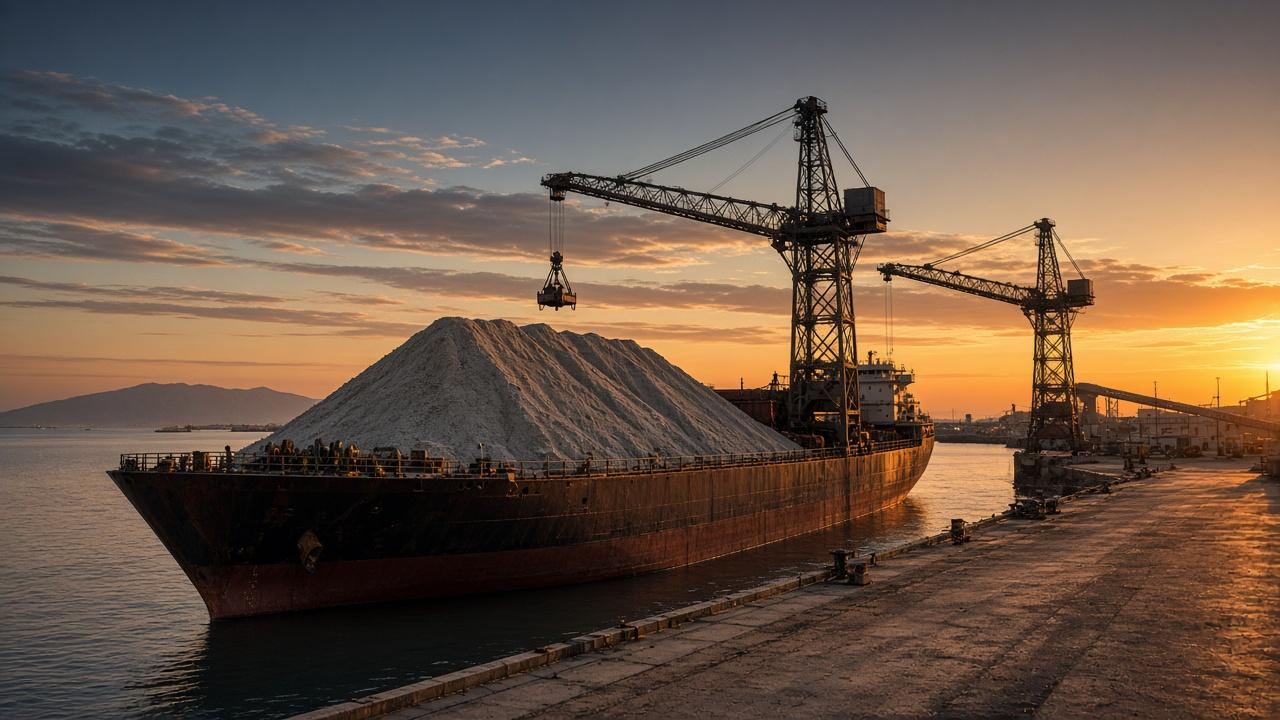
Lock the form, the hold standard, the moisture rule and the discharge plan before you talk price. Bulk urea is a free-flowing fertilizer cargo only when those four are real. "Urea 46" is market shorthand for the ordinary nitrogen grade buyers ask about. It is not a certificate, and it is not a nitrogen assay of any NAGTAR lot. The desk confirms the lot. It does not publish a standing analysis. The product is urea. Prill versus granule, which changes the cargo even when both are bulk, is in prilled or granular urea.
Urea is a nitrogen fertilizer and an industrial feedstock. It is not a cement raw material. Do not plan it as a mineral stem that happens to use a dry-bulk ship.
What buyers mean by bulk urea
Bulk means the particles go in the hold, or in a lined container, without a bag around each dose. The receiver takes them with grabs, a hopper, a conveyor, a vacuum or a screw, into a warehouse, a silo or a bagging line. Bagged urea is the same chemical in packs, usually small fertilizer bags or big bags, handled by labour and forklifts.
Buyers say "bulk urea", "urea in bulk", or "a ship of urea" and skip the form. The skip is expensive. Prills and granules both travel in bulk, and they cake, dust and discharge differently. A bulk enquiry that does not say prilled or granular is an enquiry for a hold full of an undecided product. Say the form in the first line. If you are still choosing, read the form note and decide before you ask for a freight rate.
They also say "urea 46" or "46-0-0" as if the numbers were already on a certificate. In the fertilizer market those figures point at the ordinary grade people expect when they buy urea rather than a specialty. Use them to show which market you are in. Then write the contractual limits separately, and expect them to be confirmed on the lot. A recap that says only "urea 46, bulk" has not named the form, the screen, the moisture, the hold or the governing sample.
Volume is per cargo. There is no public parcel size on this desk. A handy stem and a container of big bags are both possible conversations. They are not the same ship, the same hold inspection or the same discharge.
The import decision before any price
Price is the last number that means anything, because it is a number per tonne of a defined cargo. An undefined cargo has a freight guess and a quality argument waiting.
Lock these before you compare offers:
- Prilled or granular, and a ban on switching.
- Bulk, bags or big bags.
- The hold or container standard, including which previous cargoes you will refuse.
- Moisture, and any nitrogen, biuret or size limit you will actually reject on.
- Discharge port, and whether a fertilizer terminal there can take the product at the rate you need.
- Who samples, where, and whose result governs.
- The Incoterm, the laycan, and the document list a bank or a customs desk will see.
Then ask for a price on that cargo. If a counterparty changes the form or the packing to "make the number work", they have changed the cargo. Re-open the list. Do not average it into the freight.
The import decision includes a honest look at the receiver. A buyer with a grab crane, a dry warehouse and a bagging line can import bulk. A buyer with a rented shed and a fleet of trucks for palletised bags should import bags, even when the tonne looks dearer, because the bulk ship will arrive to a terminal that cannot take it. Demurrage eats the difference quickly. A first import is often bags or big bags for that reason: you learn the lot before you own a hold.
Industrial feedstock imports follow the same lock-list, with different reject lines. A melt plant may care more about conditioning chemicals and biuret than about spreader size. It still cannot leave the hold blank. Write the plant's limits into item 4, and do not copy a fertilizer blend spec if you do not run a blend.
NAGTAR will price a qualified lot against a finished brief. A price indication on "urea 46, any form, any packing" is not an offer you can fix a ship on.
Specifications desks ask for
The specification of a bulk cargo is short, and every line should be testable at loading.
Form and size. Prilled or granular, plus the screen you will use if you have one. Market talk of prills around 1 to 2.5 millimetres and granules around 2 to 4 millimetres is only talk. The lot's own screen is what a surveyor can sign. Fines belong here too. A dusty bulk stow is how caking starts and how neighbours complain at discharge.
Moisture. State a maximum if you have one, measured by a named method at loading. Urea is hygroscopic. The figure at the hatch is not the figure in a pile that sat open in rain. If you need a limit at arrival, say so, and accept that the hold, the weather and the discharge time will be part of the argument. "Dry bulk" is not a moisture specification.
Nitrogen. Buyers ask about the 46 percent market grade. If a minimum nitrogen content is a contractual reject, it has to be a test on this lot. NAGTAR does not publish a standing assay and will not print a nitrogen percentage as a fact of supply. The certificate, if nitrogen is agreed, is the certificate of that cargo.
Biuret. Ask for it when foliar use, a sensitive blend or an industrial recipe makes you enforce a limit. It is confirmed on the lot when supply can report it. It is not a published house number.
Conditioning and contaminants. Ask whether an anti-caking treatment was used if your process cannot take it. For bulk, also think about physical contamination: rust scale, previous-cargo crust, grain, coal, cement dust. Those are hold and inspection items as much as laboratory items. A clean assay on a scooped sample from the top of a dirty hold is how contaminated cargoes still pass a thin survey.
Leave agronomic advice off the specification. The desk sells a defined particle in a defined hold. It does not write a fertilizer recommendation.
Uses and the wrong cargo
Fertilizer programmes. Bulk urea feeds a national or a regional season: a terminal, a bagging line, a blender, a spreader. The wrong cargo is the right chemical in the wrong form, or in a hold that dirtied it, or in bags when the crane was booked for bulk. A season does not pause while you re-screen a ship. Match the form to the prill and granule note and match the packing to the terminal you named.
Industrial feedstock. A plant that dissolves urea can take bulk if it has a clean intake and a hopper that survives the particle you bought. It can be the wrong cargo when the lot is a conditioned fertilizer full of fines, or when the discharge drops the product on an open quay in the wet. Industrial buyers should say they are not running a farm programme, so nobody offers them a retail bag by reflex or a dusty prill because it was the fertilizer parcel of the week.
The cargo urea must not be. It must not be booked as a cement or clinker raw material. It must not be used to finish a mineral stem. A ship that has just carried urea is a cleaning problem for the next mineral, and a ship that has just carried clinker, cement or sulphur is a cleaning problem for urea. If your group buys both, keep the procedures separate. The convenience of one agent does not make one hold fit both products.
A wrong cargo also includes the right urea in the wrong quantity shape. A full hold offered to a receiver who can only warehouse a fraction will sit on the quay. Split the stem, or do not buy the parcel. There is no duty to take a larger ship because bulk "usually" moves that way.
Packing, the hold and discharge
Bulk versus bags is a handling choice with quality consequences.
Bulk, in a ship, is the format for a receiver who can discharge at a fertilizer terminal or an equivalent berth. You need gear or shore cranes, a hopper that can take the product, covered conveying if dust and rain are a problem, and a shed or a bagging line ready before the ship arrives. The hold has to be clean, dry and fit. Inspect it before loading, not after a mate has already started the belts.
What a careful hold check looks for: remnants of the previous cargo in the frames and the tank top, loose rust scale that will fall into white or pale granules, wet bilges, damaged hatch covers, and a previous cargo you listed as incompatible. Cement, clinker, coal, petroleum coke, sulphur, grain and strongly coloured or odorous goods are the usual refusals buyers write down. Write yours before the vessel is fixed. A cleanliness certificate that says "swept" is weaker than one that says the previous cargo, the cleaning method, and that the holds were inspected empty by the party you named.
During the voyage, hatch leakage and sweat are the moisture events that turn a free-flowing stow into a crust and a caked core. Prills, with more fines, usually cake first. Granules cake when the fines fraction is already high or the leak is serious. Neither form enjoys an open hatch at sea. At discharge, rain on an open hold wets the surface the grab is about to take. Stoppage rules in rain belong in the operations note, not in a hopeful reading of the loading moisture.
Discharge at a fertilizer terminal is a sequence. Draft survey or other agreed weight method before and after. Grabs into a hopper, not onto an open pile in the rain if you can avoid it. Conveyor to a covered store, or direct to a bagging line. Trimming and the last tonnes in the corners, where contamination and lumps collect, need a plan so they are not quietly averaged into the clean parcel. Dust at the hopper is a loss and a complaint. Wind limits are operational. Free time and demurrage are commercial, and they depend on a terminal that can actually take the rate. A bulk stem fixed into a port that can only work geared vessels slowly, or that has no covered hopper, is a discharge plan that was never a plan.
Bags avoid most of the hold-coating problem when they stay intact. They bring their own discharge: gangs or forklifts, torn bags, wet pallets, and a slower rate. Small bags are what many retail channels sell. Big bags suit a plant that wants identity without a ship's grab. Bags inside a dirty hold can still be stained or wetted from the outside. Do not treat a bagged booking as permission to skip a look at the space.
Lined containers are the small bulk option. They need a sound liner, a container that is itself dry and clean, and a receiver who can discharge a liner without slicing it open in the weather. They are not a ship's hold, and they should not be described as one on the bill of lading.
Weight. Agree draft survey, shore scale, or bag tally, and which one governs. A bulk cargo that is weighed only by a draft survey will not match a bagging tally at destination tonne for tonne. Write the tolerance and the governing method into the contract so the shortage claim has a rule.
Documents, inspection and Incoterms
Documents describe the cargo you locked, or they describe a fiction the bank will still pay against.
Commercial invoice and bill of lading: form, packing, quantity, and a goods line that does not rely on "urea 46" alone. Prefer "prilled urea" or "granular urea", bulk or bagged, "commercial fertilizer grade" if that is what it is, "quality as per certificate of analysis". Packing list for bagged cargo: bag count, bag mass, marks. For bulk, hold numbers and a weight certificate replace a bag list.
Certificate of analysis of the lot: the tests you named, with methods, tied to this loading. Nitrogen only if it was agreed. Biuret only if it was agreed. No brochure, no previous voyage's sheet. Certificate of weight. Certificate of origin when customs or the buyer needs Algerian origin as a customs fact. Hold inspection or cleanliness certificate for bulk, issued before loading by the party the contract names. Mate's receipt consistent with the bills. Safety data sheet for the terminal. The destination's fertilizer registration, import permit or labelling rule is the buyer's to specify. Name the documents your customs broker will ask for so they are in the set, not discovered at the berth.
Inspection. Independent sampling can be built into the contract. For bulk urea the useful inspection is hold condition before loading, sampling during loading across the stow rather than one scoop, moisture and the size or fines test you wrote, and a watch on rain and stoppages. At discharge, a joint survey of crust, lumps and foreign matter protects both sides. Agree the governing laboratory before the ship sails. Two surprise labs and no clause is how a nitrogen shorthand turns into a standoff.
Incoterms. FOB: you nominate the vessel, you own the hold problem, risk passes when the goods are on board, and your laycan has to match a cargo that already passed the hold inspection. CFR: the seller arranges the ship, risk still passes at loading, so a bad hold is still your cargo once it is on board unless the contract gave you a rejection right before sailing. Read that right twice. CIF: freight plus the insurance level the Incoterm names. Caking and wet damage are exactly the losses a thin cover argues about. Add the cover you need, or do not assume CIF paid for a rained-on discharge. The loading port is stated when the lot is real. Your discharge port is stated in the enquiry, via the trade inquiry if you are starting there.
Letters of credit. Copy the goods line from the contract. Do not let a bank template insert "urea 46" as the only description. Put the analysis requirement on the document list with the tests named. A credit that demands a nitrogen figure the lot was never asked to certify will not be negotiable, even when the cargo is the product the market calls 46.
How Algerian supply is qualified
A bulk enquiry is qualified as a lot, a form, a packing and a window. It is not qualified as "Algerian urea" in the abstract.
You send the lock-list above. NAGTAR checks whether a supply path can load that form, in that packing, with the tests you named. If it can, the commercial frame includes the inspection and the documents. If the path can load the other form, or only bags, you hear that. The shorthand "urea 46" does not fill the gap. Nitrogen, if you enforce it, is whatever the lot certificate says after you have agreed to test it. Nothing on this page is that certificate.
Qualification does not include a promise of a ship, a berth or a terminal rate. Those are fixed when the cargo exists. It also does not include using urea to complete a clinker or cement programme. Different product, different hold, different brief.
What to send before anyone prices the stem
Send one page in English. The inquiry form and the urea page both reach the desk.
- Prilled or granular.
- Bulk, bags or big bags.
- Any moisture, size, nitrogen, biuret or conditioning limit you enforce, as limits, not as the words "urea 46".
- Previous cargoes you refuse, and whether you want a hold inspection before loading.
- Discharge port, how the terminal takes fertilizer, and the rate or the constraint that matters.
- Incoterm you want to discuss, quantity and laycan.
- Fertilizer programme or industrial feedstock.
If item 5 is "we will find a berth later", the price is not ready. Freight and demurrage are part of what bulk urea costs the receiver. A clean FOB number with nowhere to discharge is an unfinished import.
Is urea 46 a certificate?
No. It is shorthand for the fertilizer grade the market associates with about 46 percent nitrogen. NAGTAR does not publish a standing nitrogen assay. If you need a minimum, it is agreed as a test on the lot and printed on that lot's certificate of analysis. The bill of lading should still name the form and the packing.
Should a first import be bulk or bags?
Bags or big bags, unless you already have a fertilizer terminal that can discharge bulk into cover, and a warehouse that can keep the lot dry and separate. Bulk is the right tool when that terminal is real. It is an expensive sample when the only receiver is a shed and a fleet of trucks.
Which previous cargo makes a hold unfit?
The list is yours to write, and it should be written before the ship is fixed. Buyers commonly refuse cement, clinker, coal, petroleum coke, sulphur, grain and anything that leaves a colour, a smell or a crust. A swept hold that carried one of those is not clean because the certificate says swept. Name the previous cargo and the inspection party.
Where should moisture be sampled?
At loading, across the stow, by the method in the contract, if the certificate is supposed to govern. A single scoop from a dry corner will not describe a parcel that meets rain at the hatch. Arrival sampling answers a different question, including the voyage. Say which question you are paying the surveyor to answer.
What is the minimum to lock before a price?
Form, packing, the hold rule, the reject limits you truly use, the discharge port and how it works, the governing sample, and the Incoterm. Quantity and window sit beside them. A number offered without those is a budget guess. It is not a cargo you can nominate a vessel against.
Can the form stay open until the hold passes inspection?
No. The hold is inspected for the form you already named. Prills and granules are different products in the same ship shape. Leaving the form open until loading day means the documents, the receiver and the reject limits are open too. Fix the form, then inspect the hold for that cargo.