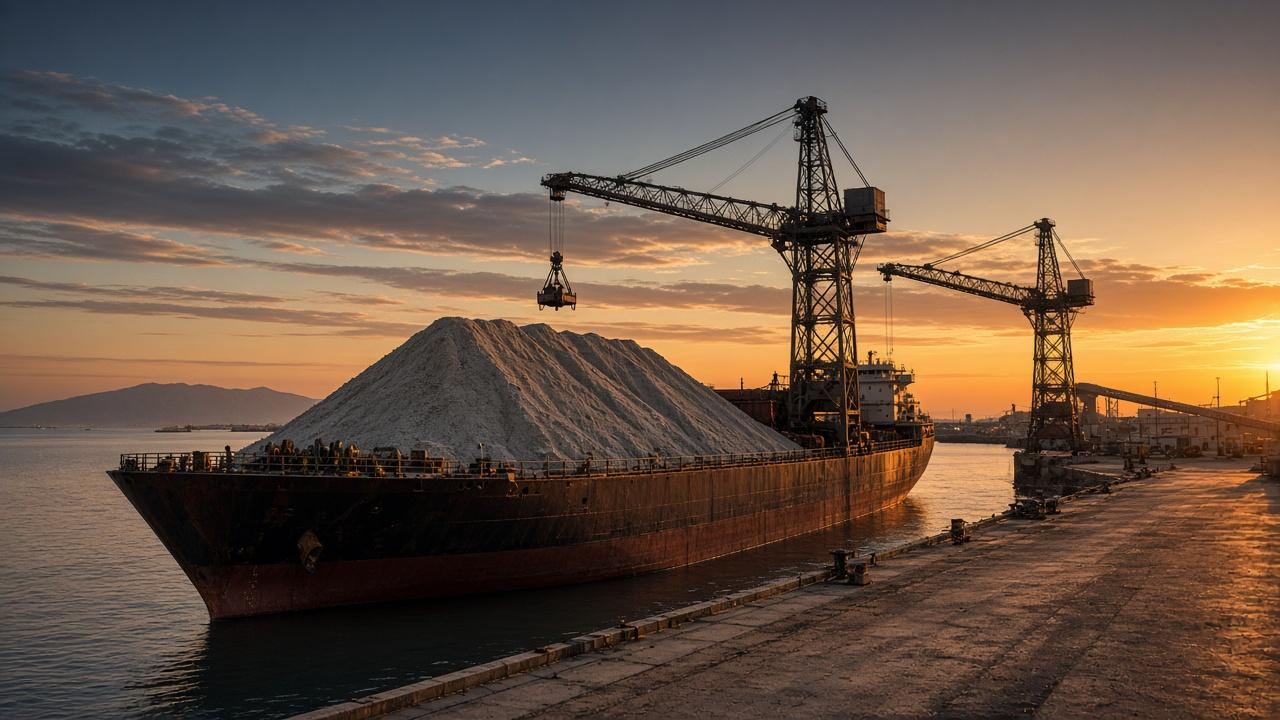
Silica sand for glass is an industrial sand with a size band the furnace can melt and a chemistry the colour can live with. The two numbers buyers actually argue about are silica, reported as SiO2, and iron, reported as Fe2O3. Both are parameters you send. They are not figures we publish for a generic sand. The product is silica. A flour, or a cut tight enough to be a filler, is a different buy on specialty silicas, and the distinction is set out in silica sand versus silica flour. How a cargo of sand is booked sits in bulk silica sand supply.
This is not a beach. It is not a construction fill that happens to look pale. And it is not interchangeable with a foundry sand just because both are mostly quartz.
What buyers mean by silica sand for glass
A glass buyer means the sand that will be weighed into a batch, melted, and judged later as colour, stones and cords in the finished ware. Sand is the largest raw material in a typical soda-lime batch, so a small shift in iron or in coarse grains shows up in a lot of glass. The order is a raw material specification, not a geological description.
SiO2 is the request for how much of the sand is actually silica. A lower result means more of something else: alumina, iron, lime, or a loss that the batch calculation did not expect. Fe2O3 is the request for iron, which colours soda-lime glass toward green or amber as it rises. How tight that ceiling must be depends on the ware. Flint and colour-sensitive work sit far from a green container furnace that already runs iron on purpose. We will not guess which furnace you have. You send the ceiling, the unit and the method. We say whether a qualified lot can be offered against it.
Other words travel with the same brief and do not mean the same product. "Glass sand", "silica sand", "quartz sand" and "white sand" are used for glass, for foundry, for filters and for construction. Colour in a photograph is not an iron result. A foundry sand can be an excellent moulding material and still miss a glass iron ceiling, or miss it the other way: a glass sand can be the wrong grain shape and the wrong distribution for a binder system.
In French notes the word silice is wide enough to cover a sand, a lump and a flour. An offer that stops on that word has not chosen which one you are buying. Reply with the use and the size, not with a translation.
Fines and flour are the adjacent mistake. A silica flour is ground. A glass sand is a sand. Dust in a glass sand is a problem (carry-over, batch segregation). A flour is the product when a filler, a ceramic body or a tight cut needs that grinding. If your specification is a particle-size curve with a d50, or a residue that only a mill can meet, you are not on this page.
The decision
Name the ware and the furnace constraint first. Container, flat, tableware, fibre, sodium silicate, or a foundry that was mis-filed under glass: the tests change. Then name the size band and the iron ceiling you will reject on. Then ask whether a bulk industrial sand can meet that, or whether the brief has already become a specialty cut.
Colour use decides how hard you press Fe2O3. If you decolourise, or if the customer rejects a green tint, iron is a primary clause and so are the colouring minors you actually test, often chromium and sometimes titanium. If you make a reduced amber or a green bottle and iron is part of the colour plan, you still want a stable result, not an absent one. Send the window, both floor and ceiling if you have them. A supplier cannot stabilise a colour you have not defined.
Size decides melting behaviour. Grains that are too coarse survive into the melt as stones or dissolve late. An excess of dust segregates in the silo, rides the furnace draught, and shifts the batch chemistry from the weight you thought you added. Give a top size, a bottom size, and the fines limit you care about, on named sieves. "Fine sand" is not a band. If you need a distribution tighter than a normal glass sand, say so early. That request may belong with specialty silicas rather than with a cargo sand.
Moisture is a weighing decision as much as a quality one. Wet sand is heavier, so a batch house that does not correct for moisture under-doses silica and over-doses the other raw materials relative to the dry formula. Your limit should match what the plant can measure and dry, not a number copied from a drier climate. Free moisture on the loading composite is the figure that matches the ship. A quarry sample from a dry week does not.
Cullet rate belongs in the brief when it changes how much sand impurity the furnace sees. A high-cullet plant and a low-cullet plant do not run the same colour arithmetic. Tell us which you are. We will not reconstruct a sand specification from a bottle you disliked last year.
If the decision is "construction sand, if it is cheap", it is not a glass order yet. Write the tests or wait.
Specifications
Ask for the parameters the batch and the furnace will police. A long multi-element sheet that nobody at the plant retests is how a sand gets rejected on a line that was never the duty.
The core chemical request for glass is SiO2 and Fe2O3, plus alumina where the batch calculation treats Al2O3 as a real input, and loss or moisture so the dry basis is clear. Chromium, titanium and other colouring oxides belong on the sheet if your lab runs them. Heavy-mineral contaminants, the grains that survive as stones, belong on it if you have had stones and you know which minerals your lab looks for. Send the method. A result without a method cannot be repeated at the other end.
We do not print house limits for any of these. Two glass plants can both be serious and still not share one iron ceiling. The number in the contract is yours, checked against the qualified lot. If the lot cannot meet it, the answer is that this sand is the wrong product for that furnace, not a rounded certificate.
Size is a table of sieves or a top and bottom with a fines cap. Say whether the result is on the as-received sand or after a preparation step your method includes. Washing, drying and screening change both moisture and the fine end. If your current supplier washes, and your limits assume a washed sand, write "washed" as a process fact you need, not as a brand. We will not assume it from the word glass.
Physical extras some buyers add, and should add only if they will test: clay or a silt fraction, organic matter, and a chloride or salt limit where the plant has been hurt by it before. Salt is one reason a literal beach sand is the wrong object. Shell and carbonate are another: they change the lime balance in the batch and they are not a quartz specification.
Foundry specifications that sometimes get pasted onto a glass inquiry are a grain-fineness number, a clay content, a grain shape and a sintering or refractoriness check. Those describe a moulding sand. They do not replace SiO2 and Fe2O3 for a furnace. If you need both a foundry approval and a glass approval, you need two specifications, and you may need two lots.
Report the basis. Dry and as-received iron or silica will not match if the sample is wet. Contracts that mix the bases invent a gap. One laboratory, named methods, and a reserve sample from the loading composite are the practical controls. A brochure grain-size curve is not.
Uses and the wrong product
Glass is the use this page is for, and glass is not one use. Container furnaces, float lines, tableware, fibre and chemical silicate do not share one iron ceiling or one size band. The wrong product inside "glass" is a sand qualified for a tolerant green container and shipped against a colour-sensitive ware, or the reverse: a tight, expensive cut bought for a furnace that never tests past a wide band. Match the lot to the ware you will make on that campaign.
Foundry sand is a moulding material. Distribution sets permeability and finish, grain shape sets how the binder packs, and fines and clay change strength and gas. Iron is often secondary unless the casting cares. A glass sand can fail a foundry for shape or for being too narrow. A foundry sand can fail a furnace because Fe2O3 was never run to a glass method, or because coarse grains remain. The shared name is not a shared duty.
Construction sand is a grading and a cleanliness problem for concrete, mortar or fill. SiO2 and Fe2O3 are usually not the rejection clauses. Paying glass discipline for a yard is a waste. Putting that yard sand into a furnace brings the iron, alumina, coarse fraction and silt the pit happens to have. If the inquiry is construction, say so. The product name on the invoice will not upgrade it.
Send the use in the first line.
Flour and high-purity or tight cuts are the leave-this-page case. Grinding changes the product: flow, dust, moisture pickup, packing and the tests that matter. A glass sand analysis does not stand in for a flour. The buyer who needs that cut should move to specialty silicas and read sand versus flour before asking for a hold.
Shore sand is quartz plus what the sea sorts: shell, salt, organic films, a worn grain. It is not a quarry we will discuss, and a photograph of dunes is not an Fe2O3 method. Glass sand is screened from a deposit, with chemistry on the lot.
Packing and cargo
Glass sand moves as bulk unless the receiver cannot take a hold. The cargo questions, including contamination from the previous cargo and how moisture is managed in a ship, are in bulk silica sand supply. What belongs here is the link between packing and the glass tests.
Contamination is a glass failure even when the sand in the quarry was fine. Iron ore, bauxite, cement, a rusty hold, or a dusty previous cargo can move Fe2O3 and alumina more than the deposit ever did. The hold standard and the cleanliness survey are part of meeting an iron ceiling. They are not a shipping courtesy. If your ceiling is tight, say so before the ship is fixed, because not every hold that is "visually clean" is clean enough for that number.
Moisture pickup in the hold changes the weighing problem you already have at the batch house. A sand loaded dry and discharged wetter is a different batch ingredient. Hatches, rain and a wet previous cargo are the practical causes. The specification should say which moisture the price and the complaint refer to: loading composite, or a discharge sample taken under a rule you wrote in advance.
Fines segregate in silos, holds and long conveyors. A grab from one hatch corner is a poor picture of the band. Specify the band so a composite can meet it. One failed spot sieve, against a composite that passes, is not automatically a claim.
Bags suit a trial, a plant with no bulk intake, or a size that must stay out of the main silo. They are a poor default for a furnace that consumes sand as its main raw material. An approval on bags is an approval of that packed lot. The later bulk stem needs its own sample.
Lump is a different form. A furnace set up for sand does not want it. If the brief says lump, it is not this order.
Documents, inspection and Incoterms
The certificate should list SiO2, Fe2O3, the other oxides you named, moisture, and the size results, each with a method, a laboratory, a date and a basis. A certificate that says "silica sand, suitable for glass" is a sentence, not an analysis. If chromium or a heavy-mineral check is in the contract, it has to be on the paper. Absence of a line is not a pass.
Sample during loading, across the parcel, and keep a reserve. Glass claims about iron and about coarse grains are decided on that sample more cleanly than on a scoop from a wet quay pile weeks later. Discharge testing is still worth doing for your batch house. Using it as the only referee requires a chain of custody the contract has described. Split the work: chemistry in the laboratory you named, size on sieves you named. A draft survey does not speak to either.
Independent inspection is justified when the iron ceiling is tight or the parcel is large enough that a mistake is a campaign of glass. The inspector checks hold cleanliness against the standard you wrote, the sampling, and the weight. Cleanliness for a glass sand is a specification item. Write it where the inspector can fail the hold before loading, not in a mail after the spout has run.
Incoterms follow the same set we use on other bulk minerals. FOB loads the cargo on board at the Algerian port and leaves freight, insurance and discharge with you. CFR adds the freight to the named port, insurance stays yours. CIF adds insurance at the level the contract states. FCA is the usual conversation for bags or containers. Risk and the condition of the hatches need to match. If rain after loading is your risk, your cover and your discharge plan have to assume it. The export papers are the invoice, the bill of lading, a certificate of origin from the competent chamber, the weight document and the analysis. None of them widens an iron ceiling.
Payment terms sit with the Incoterm because Algerian export proceeds go through a bank domiciliation. Fix that while the specification is still being argued. A perfect sand and an unworkable payment structure is not a shipment.
Algerian qualification
We match a glass brief to a lot that can show the tests you named, in a size that is actually screened, and a port that can load it clean. We do not match it to the word silica, and we do not keep a public list of pits. A lot that has been used for construction or for a tolerant application is not, by that history, a glass sand. It becomes one only if the analysis and the size meet your sheet.
If the sheet is tighter than a bulk sand is prepared to, we say so and point the brief at specialty silica rather than stretching a cargo analysis. If a previous cargo's certificate is all anyone can find, that certificate is a sample of reporting style. The next hold needs its own.
Export formalities are a registered exporter, domiciliation, and customs at the load port. Sector authorisations, where the product needs them, are checked before a quote is treated as firm. The load port is chosen with the lot and the ship, including whether that berth can offer the hold cleanliness your iron ceiling implies. Screening of buyer, receiver, vessel and destination is part of the same qualification. The surrounding steps are on the supply and export process page.
What to send
Send the use in one line: the ware, or foundry, or construction, not "silica". For glass, send the size band on named sieves, the SiO2 requirement, the Fe2O3 ceiling or window, any other oxide you reject on, and the moisture limit with the basis. Add cullet practice if it changes the colour arithmetic, and say whether the sand must be washed. Then volume, destination, bulk or bags, laycan and Incoterm.
Attach the method names or the page of the standard your laboratory will repeat. Mark which lines of an old supplier certificate are mandatory. Leave the other lines off the new contract.
If the file is a flour specification, send it on the specialty silica path instead. For a genuine glass sand, use the trade inquiry and select silica. We will tell you whether a lot can be qualified against that sheet, or which clause makes it a different product.
Is construction sand acceptable if the colour looks pale?
No. Pale is not an Fe2O3 result, and a concrete grading is not a melting band. Construction sand is bought on a size envelope and a cleanliness test. Glass sand is bought on SiO2, iron and a band the furnace can digest. If the duty is construction, say so and do not pay for a glass sheet you will not test. If the duty is glass, a cheap construction sand is the wrong product even when a sample looks white in sunlight.
Why will you not publish an iron limit?
Because the limit is a property of your ware, your cullet rate and your colour tolerance, not a property of the word sand. A number we printed would be wrong for the next furnace. Send Fe2O3 as a ceiling or a window, with the method. We compare that request to the qualified lot and answer yes or no. The same rule applies to SiO2. A floor you do not have is not a reason for us to invent one.
When should I leave this page for a flour?
When the specification is a ground product, a filler curve, a d50, or a purity and iron pair that a screened sand is not prepared to meet. Those briefs are specialty silicas. The practical difference between a sand cargo and a flour is in silica sand versus silica flour. Sending a flour target to a sand inquiry wastes a round of offers and usually the ship you thought you were fixing.
Can one cargo serve both a foundry and a glass plant?
Only if you have written both specifications and a lot meets the stricter line of each. That is rarer than a shared product name suggests. Foundry distribution, shape and clay do not answer a glass iron method, and a glass band does not answer a moulding-sand approval. If you have two customers, qualify two uses. If one of them is the real one, drop the other from the contract so a surplus test does not sink a sound lot.
Why is beach sand not a fallback?
It is a different material and not a supply we treat as a quarry. Shell, salt, organic matter and a water-worn mix of minerals sit outside a glass sand specification, and an iron test on a dune photograph does not exist. Industrial sand for a furnace is screened, sampled and documented as a lot. If the evidence you have been sent is a shoreline, ask for sieves and chemistry or decline it.
What is a usable size description?
A top size, a bottom size, and a fines limit, each tied to a sieve you can name, plus whether the test is on the sand as loaded. Add a coarse-grain limit if stones are the defect you fear, and a dust limit if carry-over or silo segregation is the defect you fear. "Glass grade" and "fine" are not descriptions a surveyor can fail. If the band is tighter than a normal screened sand, say that in the inquiry so we can tell you whether the brief still belongs on the silica cargo page.