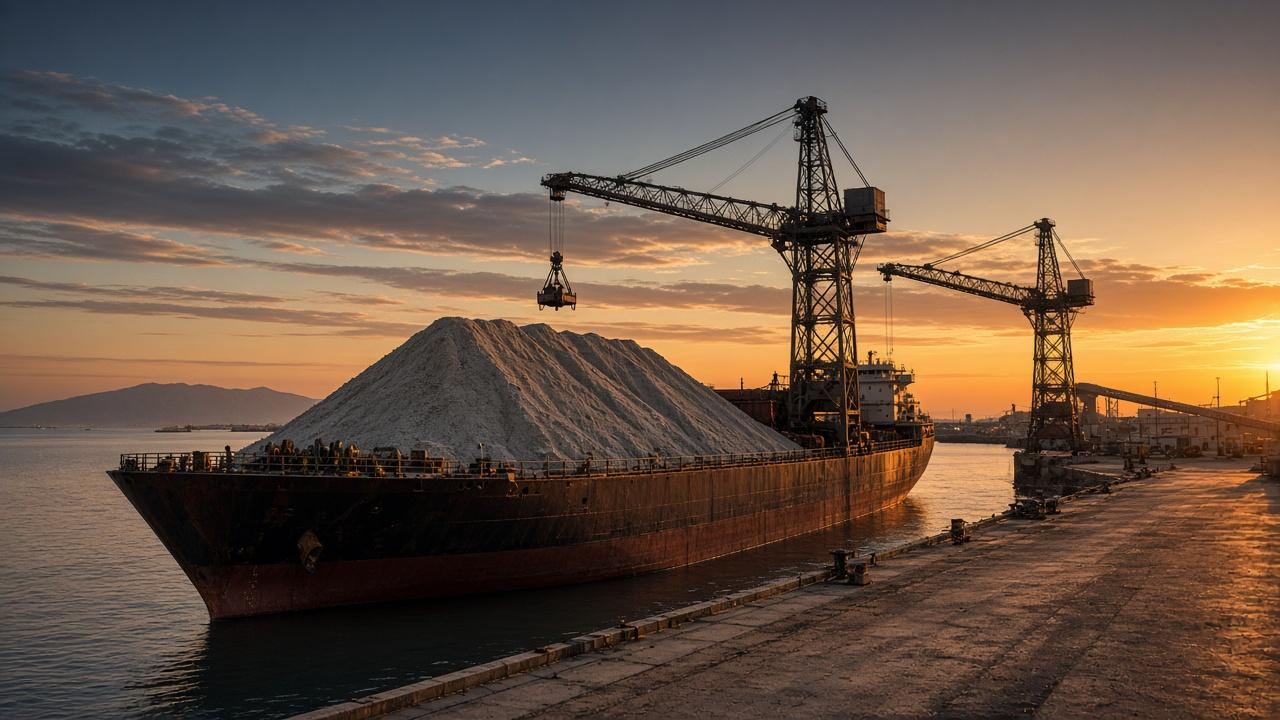
Fix the fraction before the vessel. Bulk dolomite fails when the cargo is booked as dolomite in a round tonnage and nobody has said whether the hold will carry a coarse flux stone, a tighter glass cut, or a grind full of fines. Those are different cargoes. They do not share a stowage factor, a draft result worth arguing about, or a receiver.
Working cargoes for this industrial bulk line fall between 5,000 and 30,000 tonnes, depending on the fraction and the vessel, and they are confirmed per shipment. That bracket is the range we actually discuss. It is not a promise that a given lot will fill a given ship. The uses that sit behind the fraction are set out in dolomite for steel, glass and agriculture. The product page is dolomite. This note is the order in which a buyer should lock the cargo.
What buyers mean by a bulk dolomite cargo
A bulk cargo is a mineral loaded loose into a hold, weighed as a mass, and discharged by grab, conveyor or both. It is not a pile of big bags that happen to add up to a ship, and it is not a container programme with the word bulk in the email. When a buyer says they want to import dolomite, they usually mean this: a dry-bulk ship, a fraction their plant can take, and papers that separate weight from quality.
The word dolomite still has to be earned. The stone is a calcium-magnesium carbonate. A high-calcium limestone is a different rock, even in the same size. The cargo description should say raw dolomite, the fraction, and the use, so that a calcined product or a limestone cannot be substituted under a vague bill of lading. Calcined dolomite is a different booking. If the specification assumes the stone has already been burned, stop and change products before anyone talks about hatches.
"Supplier" in this trade means the party who can show a lot, a fraction and a loading path, not a name on a list. A dolomite supplier who offers "Algerian dolomite, bulk, prompt" without a sieve specification is offering a category. We do not pass that sentence on. The inquiry we can work starts with the cut you will accept, then the chemistry you enforce, then the tonnes.
Buyers sometimes arrive with only a discharge port and a monthly appetite. That is enough to start a conversation and not enough to fix a ship. The appetite has to become a fraction and a stem. Until it does, any freight idea is a guess about cubic metres.
The decision: fraction before vessel
The fraction is the decision that sets everything downstream. It decides how the stone is crushed and screened, how much fines the pile will carry, how it stows, how it behaves if it gets wet, what the draft survey is really weighing, and whether the receiver's hopper was built for it. Choosing the ship first, because a vessel is open in a given week, inverts that order. The open ship becomes the specification. The plant then inherits whatever cut could be loaded in time.
Fix the fraction in sieve language. Top size, bottom size, and a limit on the material passing the smallest screen you care about. "0 to 30" with no view on the dust inside that range is how a glass plant or a steel shop discovers that a third of the mass is fines. If the fines have a separate limit, write the limit. If they do not, expect them to be whatever the crusher and the grab produce, and do not claim surprise at discharge.
The second decision is one fraction per hold. A stem that is short on coarse stone should not be finished with a finer pile so the ship sails full. The two cuts will not separate at the grab. If you truly need two fractions, they are two holds or two voyages, two sampling plans and two lines on the invoice. Freight looks cheaper when they share a ship. The claim looks expensive when they share a hopper.
The third decision is the tonnes, inside the range the fraction and the ship can actually carry. A coarse, free-flowing stone can sit toward the upper part of the 5,000 to 30,000 tonne bracket when the vessel, the berth and the draft allow it. A finer, wetter cut may be a smaller parcel because of stowage, because of the receiver's intake, or because the ship rightly asks harder questions about moisture. We confirm the parcel per shipment. We do not round every inquiry up to the top of the bracket to make the freight look efficient.
Only after fraction, hold plan and a realistic tonnage do we talk about the named ship. Laycan, load rate and port come with that conversation. They do not replace it.
Specifications that change the cargo
Size changes the cargo more than a one-line chemistry ever will. A result that says the stone is dolomite can be true of three piles that cannot share a contract. The sieve test on the pile you will load is the specification that operations feel: at the screen, at the grab, in the hopper and in the silo. Oversize blocks a grid. Fines blind a filter, blow off a conveyor and, in a steel shop, change the mass that reaches the furnace. In glass, the wrong cut segregates or melts unevenly. In agriculture, a coarse stone is simply slow.
CaO and MgO confirm you are shipping dolomite rather than limestone, and they confirm the lot against the buyer's floors. They do not tell the ship how many cubic metres to reserve. Silica, iron and alumina matter to the use, as the companion note describes, and they stay limits on the lot. We still do not publish a chemical window. A cargo specification that leads with a chemical slogan and leaves size as "commercial" is backwards. Size is commercial.
Moisture changes weight and, on a fine fraction, carriage. The draft survey sees wet tonnes. If the sale is dry, the contract needs a moisture method agreed before loading. If the fraction is fine and the pile is wet, the ship will ask for a declaration that matches the cargo, not a declaration written for a coarse dry stone. We treat that as part of fixing the cargo. We do not shop for a vessel that will skip the question.
Fines are both a quality limit and a production fact. Crushing makes them. Screening can remove them. Handling makes more of them. A fines limit that is tighter than the loading method can keep is not a limit. It is a future claim. The honest fix is to change the screen, change the handling, or change the limit before the vessel is nominated. Putting the dust back on the coarse pile to recover weight is a change of specification. It needs consent, a new sample and a new description. It is not a night-shift courtesy.
Bulk density, or the stowage factor derived from it, is measured or estimated for the fraction in the condition it will be loaded, wetness included. A figure copied from a different cut, or from a dry laboratory beaker, will mis-state the hold. We do not keep a single stowage factor for dolomite on the desk.
Uses that set the fraction, and the wrong cut
The use tells us which wrong cut to refuse. It does not replace the sieve line. Steel flux and steel feedstock buyers usually need a sized stone and a firm view on fines. A grind sold into that hopper fails even if CaO and MgO are exactly what the shop wanted. Glass batch buyers usually need a tighter, often finer cut, and a hold that will not add iron from rust or from the previous cargo. Agricultural buyers usually need the grind, and they will not thank you for a flux stone described as "the same dolomite, just larger".
Those are tendencies in how buyers write, not a millimetre chart we publish. The buyer's own range is the one we qualify. If they have no range yet, the first job is to get one from the plant, not to let the available screen deck become the specification by default. Available stone is a supply fact. It becomes a contract only when the receiver agrees.
The wrong cut is also the right cut loaded so that it arrives wrong. A coarse fraction that shatters under a long grab cycle can fail its own fines clause at discharge while the loading sample still passed. If the receiver's limit is tight, the loading method, the number of handlings and the discharge gear belong in the recap. Ignoring them is how a qualified pile becomes an off-spec ship.
Calcined product is the wrong cargo entirely, not merely the wrong cut. So is limestone. So is a mixed "dolomite and quarry waste" stem dressed with a dolomite certificate taken from the clean pile only. The use note covers steel, glass and agriculture in more detail. Here the point is narrower: the use chooses the fraction, the fraction chooses the cargo, and a cargo that serves none of the uses cleanly should not sail because the tonnes were available.
Packing, stowage, fines and the draft survey
Bulk is the packing. Big bags are exceptional, for a trial or a receiver who cannot take a hold, and they are a different operation. Do not plan a bag trial and assume the next bulk stem is the same product. Requalify the pile.
Stowage is agreed for the fraction on that shipment. Coarse stone and a dry grind do not ask the same cubic metres per tonne. Moisture moves the figure. The ship and the receiver decide grab, belt or both. A grind discharged only by grab, in a wind, loses the fines an agricultural buyer may have paid for. A coarse stone forced through too many transfers can arrive inside the top size and outside the fines limit. Match the gear to the cut. Trimming and rain belong in the same conversation. A fine fraction is not left open in a squall because a coarse cargo last week survived it.
The draft survey is how most stems establish weight. A surveyor reads the drafts and the ship's tables, and deducts ballast, fuel, fresh water and stores, before and after loading. The difference is a mass. It is not a sieve test and it is not a chemical test. It is only as good as the ship's constants and the ballast and bunker figures. Where a belt scale exists, the contract says which figure the invoice uses if the two differ.
The survey weighs the fines. If they are cargo, they are in the price. If fines above a limit are not cargo, the quality claim is separate from the draft. Do not expect the surveyor to deduct dust by eye. Sampling for size should see the material as loaded: increments through loading, a composite, a split for the receiver, and a sieve method named in the contract. A bucket from the top of a dry pile will show less dust than the grab will make.
Where the fraction is fine and wet enough that the ship asks for a moisture declaration, that declaration describes this cargo. It is not copied from a coarse shipment. We would rather change the parcel than sail a cargo the master should have refused.
Documents, inspection and Incoterms
The invoice and the bill of lading carry the fraction. "Dolomite in bulk" is a weak description if a fines limit can reject the cargo. Raw dolomite and the sieve specification belong in both, in the same words. Mismatched descriptions are how a file stalls after the surveyor has left.
The weight certificate is the draft survey or the scale ticket. The quality certificate is chemistry and size on the loaded lot, plus moisture if it corrects weight or sits under a carriage declaration. A result from a different fraction does not belong in the set. If a test was not run, the certificate leaves it blank.
Independent inspection at loading is worth it when the receiver cannot see the pile and the fines limit is tight. The size sample should exist even when the buyer is at the berth. Name a referee laboratory before there is a disagreement about sieves.
FOB is frequent on this mineral, because the buyer often has the vessel. CFR and CIF move the freight to the seller, and CIF adds insurance. The term does not set the fraction, the draft rule or the fines clause. Laytime and load rate sit beside it. A grind does not load at the rate of a coarse stone on the same conveyor.
How supply is qualified from the face to the vessel
NAGTAR qualifies raw dolomite in Algeria with selected supply. We do not name a quarry here. A face that is right this season can be screened differently next season, and a printed name would be read as a permanent grade. What the buyer can rely on is the path from that face to the hold, described for the shipment, not a geography lesson.
The path still has to be checked. Stone is taken from a face, crushed, screened to the fraction in the brief, and stockpiled apart from other cuts. It moves to the berth and is loaded by gear that will not quietly destroy the fines limit. A bypassed screen, a pile left in rain, a loader in the base of the stock, or a grab cycle harder than the trial, can turn a passing sample into a failing ship.
Qualification walks that path against the brief. We ask whether the fraction can be made without blending the fines back in. We ask whether the berth and the likely gear can load it inside the size limit. We ask whether the tonnes sit sensibly in the 5,000 to 30,000 tonne range for that fraction and that ship type, or whether the stem should be smaller. We look at CaO, MgO and the impurity lines on a sample of the same fraction. A pass is permission to talk about a vessel. A fail on size is not cured by a strong magnesia number.
We do not qualify "the quarry" in the abstract. Two faces, or two screen settings, are two lots. The certificate, the stockpile and the hold have to point at one of them. If supply changes face during loading, loading stops until the new stone is accepted or the stem is closed. Continuing because the ship is on the berth is how a clean first half and a dirty second half become one bill of lading the receiver cannot split.
The same discipline applies to a repeat buyer. Last shipment's sieve curve is evidence about last shipment. The next stem is checked on the points that rejected, or nearly rejected, the previous one. A monthly programme is a series of lots with a stable brief, not a waiver of sampling.
What to fix first, and what to send
Fix the items in this order. Reversing them is how freight gets booked for a stone the plant will fight.
- The product is raw dolomite, not calcined material and not limestone. Say the use, so the fraction has a reason.
- The sieve specification, including fines. This is the cargo.
- The chemistry limits you already enforce, especially CaO and MgO, confirmed later on the lot rather than copied from a published window.
- Moisture, and whether weight is wet or dry. On a fine cut, say so early, because the ship will ask.
- The tonnes, as a stem inside what the fraction and the receiver can take. Use the 5,000 to 30,000 tonne bracket as a working range, not as your tonnage.
- Discharge gear, port, and any hold-cleanliness rule.
- Incoterm, draft survey or scale, and who inspects size at loading.
- Only then the ship, the laycan and the load rate.
Send that list through the buyer inquiry, pointed at dolomite. If you are still choosing the use, read the uses note first and come back with one fraction. A price and a vessel name are not a substitute for step two.
What cargo size should I plan for?
Plan inside 5,000 to 30,000 tonnes, then let the fraction and the vessel set the stem. A coarse stone on a suitable ship can sit higher in that range. A finer or wetter cut, or a receiver with a small intake, should be planned lower. The figure is confirmed per shipment. It is not a standard parcel we guarantee, and it is not a reason to blend two fractions so the ship looks full.
Why do fines change the shipment?
Fines change what the receiver can use, what blows off at the grab, how the cargo stows, and how a wet fine cut is declared to the ship. They are also weight. The draft survey includes them. If your contract says material passing a certain screen is limited, that limit has to be true of the loaded cargo, not only of a washed sample. Making weight by putting the dust back on the pile changes the product. Agree it, or do not do it.
Is a draft survey enough on its own?
The draft survey is the weight. It does not show the fraction, the fines or the magnesia. You still need a sample of what was loaded and a sieve result when size can reject the cargo. Buyers who rely on draft alone discover the quality problem in the hopper, after the weight is no longer in dispute. Put both documents in the contract: weight by draft or scale, quality by the loading sample.
Can one vessel carry two fractions?
Only as two cargoes, in two holds, with two descriptions and two samples. A single hold with two cuts will discharge as a mixture. The freight saving is real and usually smaller than the cost of a rejected mixture. If you need a coarse steel stone and a finer glass or agricultural cut, fix two stems. Do not ask the supplier to "balance the ship" with whatever is left on the pad.
When is this the wrong product?
When the specification is calcined or dead-burned dolomite, when the rock is limestone, or when you have no fraction and want the ship to decide. Raw bulk dolomite is the carbonate stone in a named cut. The uses note explains steel, glass and agriculture. If your batch card or refractory specification says the carbon dioxide is already gone, you are not in this cargo. Say that in the first message rather than after a sample of the raw stone has crossed a border.
What should the first inquiry contain?
The fraction, the use, any CaO and MgO limits you already apply, the tonnes you can actually take, the discharge port and the Incoterm. Moisture and fines limits if you have them. You do not need a target freight rate, a named ship or a quarry preference. Send it via the inquiry form. We will say whether an Algerian lot can be qualified on that fraction, and only then whether a cargo in the working range is realistic for the vessel type you have in mind.