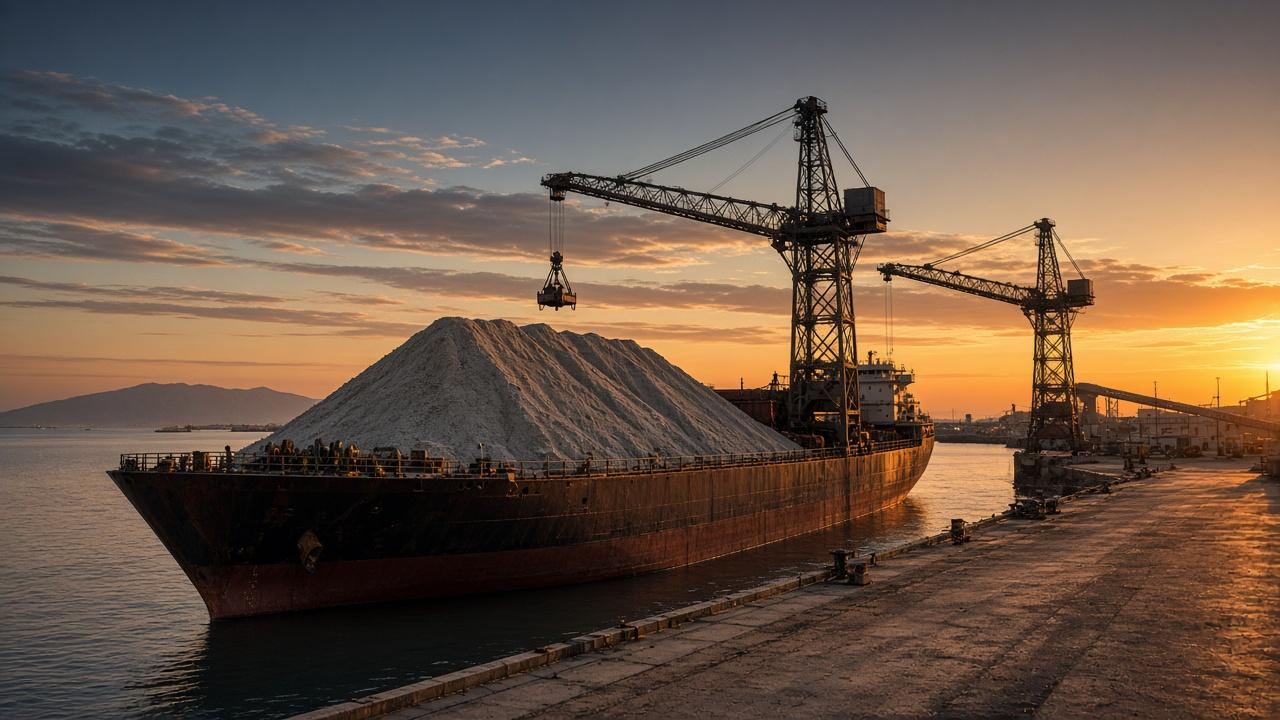
A bulk lime cargo is a named form, loaded dry, in a parcel the vessel and the receiver can both handle. We discuss 5,000 to 30,000 tonnes per cargo. The spread exists because quicklime and hydrated lime do not stow the same way, and because draft and discharge rate change the number. The figure is confirmed per shipment, not offered as either end of the range on demand. Moisture and the moment you sample decide whether the contract quality is the quality on the quay. If the form is still open, read quicklime or hydrated lime first. The product page is lime.
What buyers mean by a lime supply
"Bulk lime" in a buying note usually means three things at once: a chemical form, a ship, and an assumption that the product will still match the order after the voyage. Only the first is a product decision. The other two are execution. A lime supplier who answers with a price and a port, and has not asked which form you unload, has not started the supply.
Import quicklime is the oxide. It is the cargo for a works that slakes on site or for a steel shop that wants calcium oxide as a flux. It is not a generic word for any white powder from a kiln. Hydrated lime is the hydroxide, already slaked, and it is a different booking: finer, dustier, and chemically past the reaction that makes quicklime dangerous when wet. Buyers who write "import quicklime" and then accept a hydrate parcel because the tonne price was lower have changed the contract without rewriting it.
People also say bulk when they mean "not in small bags", and then discover the receiver can only take big bags. Bulk, in this note, means loose in a hold, trimmed, weighed by draft survey, discharged by grab or by a pneumatic or mechanical system built for the form. Big bags and small bags are a different operation. They are available when the receiver cannot take a hold, and when the lot can be packed that way. They are not a silent fallback on a bulk booking.
Dolomite is the mistake that looks closest on a spreadsheet. Dolomite is a calcium-magnesium carbonate stone. It has not been calcined into an oxide, and it is not hydrated lime. Steel, glass, agriculture and construction uses for that stone sit on the dolomite page. If someone offers dolomite against a lime inquiry, the inquiry has jumped products. Calcined dolomite is a further product again, for buyers who need the stone after calcination, and it is still not quicklime.
The decision
Decide four things before you ask a ship: the form, whether the receiver can take loose product, the tonnes that fit the berth, and where the sample will be drawn. Price comes after those four are written.
The form is not revisited in the fixture. Quicklime wants a dry hold and a receiver with a slaker or a flux system. Hydrate wants a receiver who can handle powder and a hold prepared for dust and flow. Switching after the vessel is on subjects means a new stem, often a new lot, and a new set of safety papers if the carrier or the destination asks for them. The comparison of the two forms, including why the price per tonne is not comparable, is in the form note.
The parcel size is a negotiation with physics and with the port, inside 5,000 to 30,000 tonnes. A short berth, a draft limit, or a discharge crane that cannot keep up with a large hold will pull you toward the lower part of that range. A receiver with silo space and a grab cycle that can clear a handy cargo will sit higher. Hydrated lime, being a fine powder, often limits practical stowage and discharge rate differently from pebble or lump quicklime. We do not publish a stowage factor. The master calculates it from the lot you are actually loading. Two offers with the same tonne figure and different forms are not the same ship.
Ask what happens to the balance if the berth cannot take the tonnes you first wrote. Deadfreight, a second call, or a split shipment are commercial outcomes, and they should be priced before fixture, not discovered from a draft reading on the day. A buyer who says "maximum the vessel can lift" still needs a minimum the plant can live with if the first cargo is short.
Bags are the decision when bulk is impossible, not when bulk is merely unfamiliar. No quay gear for powder, no silo, a remote job site, or a specification that requires sealed units: those are bag reasons. A preference for "easier claims" is a weak reason. Claims follow the sample and the weight method, and bags add a packing list, a breakage allowance and a warehouse at each end.
Specifications
The specification does not get looser because the cargo is large. It gets more expensive to get wrong. Write the form, then the tests the receiver will actually run on the loading composite.
For import quicklime the set that usually matters at shipment scale is available lime, residual carbon dioxide or loss on ignition, size, free moisture, and a reactivity result if the slaker or the steel shop is sensitive to speed. For hydrated lime it is available lime on the basis your standard uses, free moisture, and a sieve residue. Impurity ceilings travel only if you enforce them. We confirm the numbers on the qualified lot. A previous hold's certificate shows how a producer reports. It does not travel with the next ship.
Free moisture is the shipment parameter people treat as a laboratory detail and then meet again as a cargo problem. On quicklime, free moisture means the oxide has already met water. The pile can be heterogeneous: a wet skin and a dry core. A specification that says "moisture typical" will not help a surveyor. Say the maximum you will accept, the method, and that the result is on the composite drawn while loading, not on a stockpile sample from another week. On hydrate, free moisture is water above the water of hydration. It predicts caking and flow at discharge more often than it predicts a chemical failure.
Size at cargo scale is a handling specification as much as a process one. Pebble quicklime that carries a large fine fraction will dust, will hold moisture, and may not run in the bunker you designed for a narrow cut. Powder hydrate that arrives with lumps from storage will not meter. Give a top size and a bottom size, or a residue on a named sieve, in words a sampler can check with the equipment on the berth or in the contract laboratory. Do not write "sized for bulk".
If you discharge in two ports, say whether each parcel must meet the specification on its own sample or whether one loading composite covers the bill of lading. Those are different inspection plans. A single certificate for a cargo that is split on the voyage leaves the second receiver with no sample that is clearly his.
Uses and the wrong product
Bulk supply does not create a new use. It is a way of moving the form you already chose. Steel flux, soil stabilisation, mortars, water treatment and gas treatment each still require the form and the size in their own method. The failure mode at cargo scale is shipping a correct chemistry in a form the unloader cannot put into the plant, or shipping so much of it that the silo and the draft cannot accept the stem.
The wrong product we see most often in a bulk inquiry is a carbonate sold under a lime heading. Dolomite will not slake, will not do the work of quicklime, and should not be stuffed into a lime hold to fill a tonne target. Send that brief to dolomite. The wrong product we see next is the right calcium chemistry in the other form: hydrate into a steel bunker, quicklime into a bagged mortar plant with no slaker. Both can be honest cargoes for someone else. Neither is a substitute you discover at the hatch.
A third miss is a small certified lot used to represent a full hold. If the producer can show a clean analysis on a few hundred tonnes in a shed, that does not describe 15,000 tonnes that still have to be made, stored and loaded without rain. Qualification of a bulk stem includes the storage between production and the spout. If that storage is open to weather, the lot is not qualified yet, however good the kiln sample was.
Construction projects sometimes ask for bulk because the tonne price looks better, then have nowhere to keep an oxide dry for the weeks the project actually consumes it. In that case the honest supply is a sequence of bags, or a smaller parcel, not a hold that sits as a quarry on a job site. Water plants with a small slaker and a small silo have the same arithmetic. The range 5,000 to 30,000 tonnes is what a cargo can be. It is not what every plant should buy in one lift.
Packing and cargo
Default for this line is bulk, once the form and the receiver's gear agree. Loading is a dry-weather operation for quicklime. Hatch covers, coamings and the forecast before each shift matter as much as the certificate. If rain starts, loading stops. Restarting a damp surface under fresh oxide is how a cargo becomes two products in one hold. Write who has authority to stop, and how the time counts, before the laycan. Hydrate is less violent with a shower and still unhappy about it: caking, extra free moisture, and a discharge that does not match the trial.
Hold preparation is a document, not a promise in a recap. The hold should be clean, dry, and free of residues from a previous cargo that will react with lime or contaminate it. A washed hold that is still wet is not ready for quicklime. Who inspects, against which standard, and whether you can reject the ship, belongs next to the product specification. Lime is less forgiving than an inert mineral. A "see how it looks" acceptance is how a claim starts with no evidence.
Trimming and the shape of the stow affect both stability and what the grab finds at discharge. The master owns the stowage calculation. Your job is to give a product description the calculation can use: form, an indicative flow and size, and any practice from the load port that the ship needs to know. Do not invent a density in the purchase order. If the only density you have is from a different form, say so and let the shipper and the master close it on the lot.
Bags and big bags come in when bulk cannot be received. Marks, unit weight, and the working load of a big bag are part of the booking. So is the warehouse. Quicklime in bags still slakes if the bags get wet. Hydrate in bags still cakes. A container can keep rain off and can still sweat. If you move that way, the packing has to survive the route you actually have, not a route you hope will stay cool and dry. FCA is often the Incoterm conversation for that packing. A bulk hold stays on FOB, CFR or CIF.
Discharge rate is a cargo term. Powder and pebble do not leave a ship at the same speed, and a grab that works for pebble may be the wrong tool for hydrate. Put the intended gear in the inquiry. A demurrage rate agreed against the wrong gear is a dispute you have already scheduled.
Documents, inspection and Incoterms
Quality moves if lime is stored badly, so the inspection point is part of the commodity. Sample during loading, from increments across the parcel, and seal a reserve. A stockpile sample taken days earlier, from a pile that then sat in weather, does not describe the hold. A sample taken at discharge after the receiver has wetted a hopper does not describe it either. If a claim is likely, the reserve is what both sides still have. Name the laboratory, the methods, and the basis (dry or as-received) in the same clause as the limits.
Weight is a draft survey on a bulk parcel, or a weighbridge where the port actually weighs. The surveyor reads displacement. The surveyor does not certify available lime. Keep the weight certificate and the analysis as separate papers so a draft dispute does not get argued as a chemistry dispute, and the reverse.
Safety documents are produced when the destination, the port or the carrier asks. Quicklime and hydrated lime do not share one sheet. The oxide reacts with water and releases heat. The hydroxide is a powder that has already taken that water. The declaration the master needs follows the form on the booking. Send the request with the inquiry: safety data sheet, proper shipping name, or whatever the line has listed. We match that request for the form being shipped. We do not attach a generic sheet and leave the ship to reconcile it at the last moment.
The commercial papers are the invoice, the bill of lading in the form the contract states, a certificate of origin from the competent Algerian chamber, the weight document, and the analysis. Bagged cargo adds a packing list. Independent inspection, if you appoint it, is the inspector's certificate, not ours.
Incoterms we actually use are FOB, CFR, CIF, and FCA when the cargo is bags or containers rather than a hold. FOB delivers loaded on board at the Algerian load port. You take freight, insurance and discharge. CFR means we arrange freight to the named port and you insure. CIF adds insurance at the agreed level, and the certificate joins the set. Risk on FOB passes as the cargo comes on board. For a product that reacts with rain, that means hatch discipline after loading is your risk unless the contract says otherwise. If you want a hold-rejection right, it has to exist before the first tonnes go in. Algerian export also needs a bank domiciliation of proceeds, so payment terms are settled with the Incoterm rather than after the ship is fixed.
Algerian qualification
We qualify a stem, not a country brochure. The lot has to be the form you named, storable until loading without a weather problem we cannot manage, and loadable at a port that can take the ship you have in mind. The receiver has to be able to take it. If any of those fail, the tonne figure in the 5,000 to 30,000 range is irrelevant.
Producers are not published as a list, and one plant's ability to make pebble quicklime is not evidence it can pack hydrate, or the reverse. Where export of the mineral needs a sector authorisation, we check it on the grade before we quote. Customs declaration is at the load port. The load port itself is chosen when the lot, the packing and the vessel fit. Naming a famous port in the first email does not create a cargo.
Screening covers the buyer, the receiver, the vessel and the destination. A clean specification and a counterparty or a ship we cannot clear is a decline. The steps around the commercial frame, inspection and loading are the same sequence as on our other industrial lots, set out on the supply and export process page. Lime adds the moisture discipline and the form. It does not add a shortcut.
What to send
Send the form first. Then size or sieve residue, any available-lime or reactivity window you enforce, and the moisture limit with its method. Then the tonnes you can take in one lift, the destination, the discharge gear, the laycan or the month, and the Incoterm you want to discuss. Say whether a safety data sheet is required and who has asked for it. Say where you want the sample drawn.
If the receiver cannot take bulk, say bags or big bags at the start, with a unit weight if you have one. If the brief is dolomite or another carbonate, do not send it as lime. Use the dolomite inquiry path, or the lime path if the form is truly an oxide or a hydroxide.
The trade inquiry is the practical route. We answer with a parcel that can be fixed, or with the reason it cannot: form, storage, ship, or documents.
What size of cargo should I put in the first inquiry?
Put the tonnes you can receive and store as the form you named, and the tonnes you would like if the berth allows it. We discuss parcels from 5,000 to 30,000 tonnes, depending on quicklime or hydrated lime and on the vessel, and we confirm the figure per shipment. A single number with no discharge constraint is less useful than a range and a draft or a silo limit. If you can only take bags, say that instead of forcing the bulk range onto a job site.
Is an import quicklime booking valid for hydrated lime later?
No. The safety declaration, the hold standard, the discharge gear and the price basis all change. Treat a switch as a new inquiry. If you need both in one programme, open two lines and two releases. A recap that says "lime" and leaves the form for the mate's receipt is not a booking we will fix a ship on.
Why is the inspection point a commercial term?
Because the product changes in bad storage, and a sample from the wrong day describes the wrong pile. Loading composites, sealed before the hatch closes and before any receiver water meets the product, are what you can compare to the contract. Discharge samples still have a use for your own process control. They are a poor sole basis for a claim unless the contract says so and the chain of custody is intact. Write the point, the increment plan and the reserve into the same document as the price.
When should the cargo be bags instead of bulk?
When the receiver has no way to take a hold, when the consumption rate would leave bulk lime in the weather, or when the destination has asked for sealed units. Bags do not remove the need for dry storage, and they add marks, breakage and a packing list. Big bags need a working load and a way to discharge them. If none of those constraints exist, bulk is the default and bags are an extra operation you should choose on purpose.
Can dolomite fill a lime stem if lime is short?
No. Dolomite is a carbonate stone, not quicklime and not hydrated lime. It will not meet a lime specification, and it should not be used to top up a hold. If dolomite is what you need, the brief belongs on the dolomite supply, with its own size and chemistry. A shortage of one product is not a reason to rename the other.
Who asks for safety documents, and for which form?
The carrier, the load port, the discharge port or the importer. Ask them before you fix, and tell us what they asked for. The sheet and the shipping name follow the form. A hydrate document set does not cover an oxide cargo. If nobody has asked, do not invent a file of certificates to look complete. If somebody has asked, it is a condition of the shipment, not an annex we sort out after sailing.