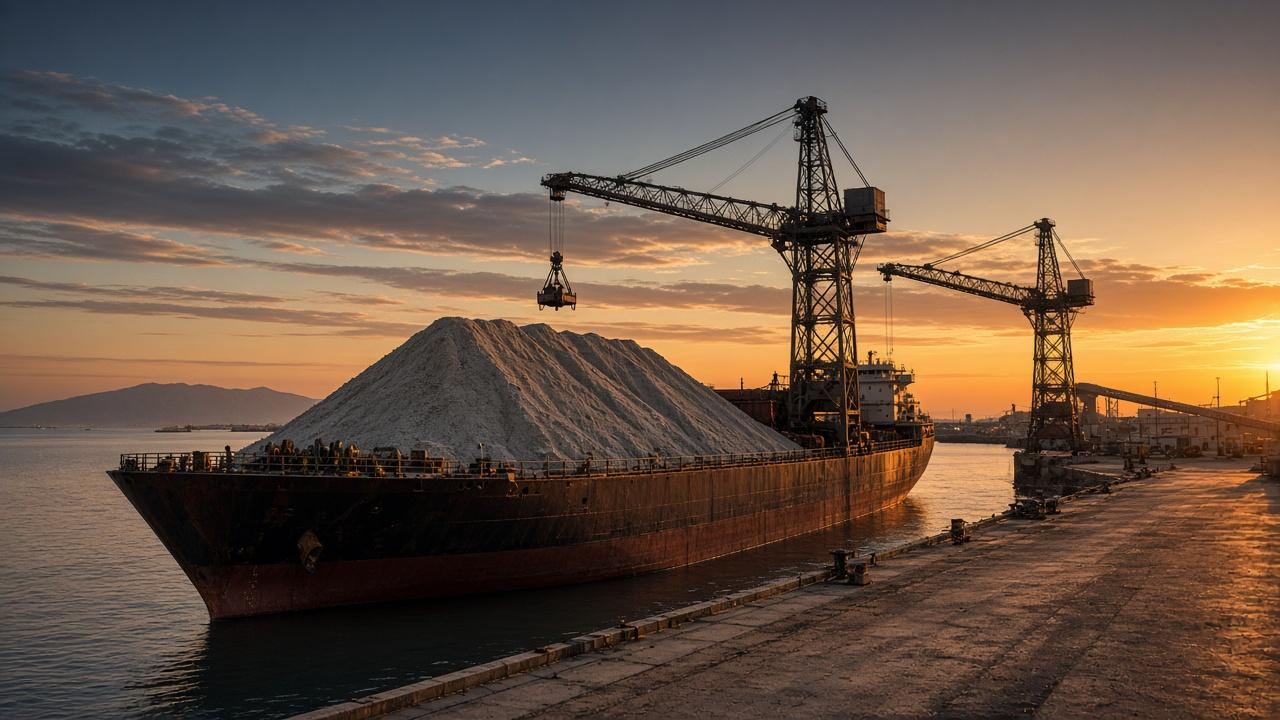
Calcined dolomite is dolomite after heat has driven off carbon dioxide. The raw stone is a calcium-magnesium carbonate. The calcined product is the oxide material that remains, which steel shops, refractory makers, and some glass batches specify when they cannot use the carbonate. Dolime is the short name many buyers already use for that calcined product. It is not a second commodity.
The raw stone and the calcined product are quoted apart. A cargo of uncalcined rock will not meet a brief that asks for calcined dolomite, however attractive the freight looks. The reverse is also true: a calcined lot is the wrong answer to a brief for raw stone in steel flux feedstock, glass batch, agriculture, or construction. Uses of the raw material are set out in dolomite for steel and glass, on the raw dolomite page. This note is the distinction. The steel and refractory brief that only the calcined product can meet is in calcined dolomite for steel.
French sheets call the uncalcined stone dolomie. It is a separate file from the burned product. The English contract still has to say whether the lot is calcined, and what that calcination has to achieve.
Dead burned dolomite is buyer language for a harder, less reactive burn, the kind refractory grain and some steel uses are written around. A lighter burn is the other end of the same conversation: more reactive, more willing to pick up moisture and carbon dioxide if it is left open. NAGTAR does not carry those as two catalogue SKUs with published assays. They are a distinction you confirm on the qualified lot.
What buyers mean by calcined and by raw
"Dolomite" on an email is incomplete. Procurement often inherits the word from a process sheet that never said whether the kiln step had already happened. A steel buyer can mean the carbonate they will calcine themselves, or the oxide they expect to charge as flux or as a refractory feed. A glass buyer can mean a carbonate in the batch, or a calcined dolomite the furnace recipe already assumes. Those are different purchases.
Raw dolomite means the stone, sized to a fraction, with chemistry and loss on ignition reviewed for that fraction when a lot is qualified. It still contains the carbonate. Anyone who heats it later is the one who drives the CO2 off. If your plant has that kiln, and the brief is written for the stone, you are on the raw page.
Calcined dolomite means that step has been done before shipment. The buyer is paying for a product whose available oxides, residual carbonates, size, and behaviour in contact with air match a shop practice. Calling it dolime does not add a specification. It only tells us you are not asking for the stone.
"Dead burned" and "lightly calcined" are the next words, and they are not decorative. Dead burned material is taken to a condition where it is comparatively inert to moisture and is used where the product must keep its character: refractory brick and many steel applications that reject a soft, reactive burn. Lightly calcined material is burned less far. It is more reactive. It is also the lot that suffers first if packing is casual. Which of those you need is a process fact. It is not a menu line we can tick without your ceiling on loss on ignition, your size, and your impurity limits.
The decision before anyone talks packing
Decide whether the receiver can use carbonate or needs the oxide. If the process specification says calcined, dead burned, dolime, or a loss-on-ignition ceiling that only a burned product can approach, the raw stone is out. If the specification is a size of rock for a kiln feed, a glass batch carbonate, a soil use, or an aggregate, the calcined product is out and usually too expensive for the job even before quality is argued.
The second decision is how far the burn must go. Write it as behaviour and as tests, not as a trade name alone. "Dead burned" without a loss-on-ignition method, a size, and the impurities you cap is a hint. "Lightly calcined" without a reactivity or a residual-carbonate expectation is the same. The producer’s temperature programme stays with the producer. We do not publish a kiln temperature as a NAGTAR fact. You will see the result on the lot: loss on ignition, the oxide picture the lab actually ran, size, and, where you ask for it, a reactivity check.
The third decision is who carries the risk of moisture and recarbonation. Calcined material can take up water and CO2 from the air, gain weight, rise in loss on ignition, and drift away from the burn you thought you bought. Dead burned product is more resistant. It is not immune to bad storage. Lightly calcined product needs tighter packing and a shorter path from kiln to closed store. If your shop cannot receive the cargo into covered storage on arrival, say so before the mode is chosen.
Price sits behind those three. A number on "dolomite" with no burn, no size, and no packing is not comparable to anything. Nothing is firm until the lot is qualified and the terms are accepted.
Specifications that are confirmed on the lot
There is no public assay for calcined dolomite and none for the raw stone in this note. Figures move with the campaign. What we can do is line the qualified lot up against the limits you send. If a result does not exist, it stays blank.
Loss on ignition is the heading that separates the two products in practice. On the raw stone it reflects the carbonate that has not been burned. On the calcined product it is one of the ways a shop checks how far the burn went and whether the lot has already picked up moisture or CO2. The method, including the temperature the lab uses, has to be yours. Two LOI numbers from two methods are not a disagreement we can settle by averaging them.
Oxides are the next heading. Shops talk about lime and magnesia because that is why they bought a dolomite product at all, and they cap silica, iron, alumina, and sometimes sulfur. Send the ceilings and floors you enforce. We share the lot’s results against that panel. We do not invent a typical MgO to keep a thread moving, and we do not treat a raw-stone analysis as evidence for a calcined cargo.
Size is a separate specification from burn. Lump, a graded grain for brick, and a fine fraction are different handling problems and often different customers. Name the range with the sieves you mean. A dead burned chemistry in the wrong size is still the wrong cargo.
Reactivity, residual carbonate, and moisture at loading are the checks that follow from how hard the burn was. Put them in the contract only if you will reject on them, and name the method. A sentence that says "must be well burned" cannot be sampled.
Uses, and the product that does not belong
Calcined dolomite is specified where the process needs the oxide: steelmaking flux and refractory practice, dolomite refractory grain and brick, and glass batches that call for the calcined form rather than the carbonate. The steel and refractory side is developed in the companion note. If that is your file, read it before you send a one-line inquiry that only says "dolomite for steel."
Raw dolomite is specified where the carbonate is acceptable or required. That includes shops and plants that calcine on site, glass batches written on the stone, agricultural uses, and construction uses where the grade allows. Those buyers should not be offered a calcined lot as an upgrade. The upgrade changes chemistry, mass, moisture behaviour, and price basis. It is a different product, on its own page.
The wrong product is the one the process sheet did not name. Raw stone into a refractory press, or into a steel shop that has no step for driving off CO2, fails the brief even if the carbonate chemistry looks familiar. Calcined product into a soil, aggregate, or carbonate glass batch fails it the other way. Lime is a further mismatch: quicklime is a calcium oxide from limestone, not this calcium-magnesium product. A flux tender that says "lime or dolomite" still has to be split before anyone qualifies a lot.
Dead burned and lightly calcined are also the wrong product for each other when the shop has already chosen. A reactive burn in a brick formulation that was qualified on dead burned grain is not a near miss. A dead burned lot in a process that needed reactivity is not a near miss either. Confirm the burn on the lot. Do not assume the word on the offer matches the last ship.
Moisture pickup, packing and why there is no standard hold
Calcined dolomite picks up moisture, and it can recarbonate, when air and time are allowed to work. The practical signs are a rising loss on ignition, caking, and a product that no longer matches the burn the shop qualified. How fast that happens depends on the burn, the size, the humidity, and whether the packing was closed. We do not publish a rate in hours or a safe storage life. Those would be inventions. What we will say is that packing and transit are part of the specification, and that the certificate describes the lot at the point of sampling, not a theoretical kiln discharge from last month.
Packing is bulk, big bags, or containers, once the burn and the destination handling are known. Bulk is realistic when the lot is large enough and the receiver can take a mineral cargo without leaving it open to weather. Big bags suit plants that dose a graded refractory or a steel addition from a store, and they limit air exchange if the bag specification is actually closed. Containers suit smaller parcels and receivers with no bulk intake. The choice is operational. It is not a house preference we apply before reading the brief.
There is no standard hold size. Calcined dolomite is not planned as a default industrial-bulk stem with a published parcel. Some lots move in bulk. Many do not. A buyer who copies a raw-dolomite vessel size onto a calcined inquiry has used the wrong product’s logistics. Tell us the tonnes you can receive, the packing you can handle, and whether the berth is even a bulk berth. We will say what is realistic for that grade. We will not stretch the lot to fill a ship.
The raw stone is the product that is discussed as a bulk cargo with a working size range. That discussion stays on the raw dolomite page. Do not import it into a calcined contract to make the nomination look normal. Weather at load, hatch covers, and open storage at discharge hurt the calcined product faster than they hurt the stone. If you choose bulk, the hold-cleanliness and the cover plan belong in the same clause as the quality.
Documents, inspection and Incoterms
The document set follows the Incoterm and the receiver. Invoice, bill of lading or waybill, weight, and a quality certificate that states the burn-related tests you named: loss on ignition by the agreed method, the oxides on your panel, size, and moisture if it is a limit. A certificate of origin when customs asks. Safety information when the destination treats the calcined oxide as a material that needs it. A raw-stone certificate with the title edited is not acceptable. The product name on the set has to be the calcined product.
Inspection is agreed before loading, especially because the product can change if it waits in the open. Sampling at the point the contract names, sealed retains, and a check that packing matches what was sold are the useful scope. An LOI test on a sample taken after a week on a wet quay does not describe the lot that left the works, and a sample taken at the kiln weeks earlier may not describe the lot that was stuffed. Write the moment.
Incoterms still only allocate freight, insurance, and risk. FOB at a named loading place means the buyer takes over as that term provides, including the risk of a cargo that must stay dry. CFR or CIF to a named destination moves the freight, and CIF the insurance, without moving the quality clause. Big bags and containers often travel under a term that names a place of loading or a terminal, not a bulk laycan. Use the term that matches the mode. Do not force a bulk Incoterm onto a container parcel because the last raw-dolomite contract was written that way.
Claims need a period and a governing sample. Recarbonation during a delay the buyer caused is a different argument from a lot that was already off-burn at sampling. The contract can separate those if you write them. A one-line "quality as per previous" cannot.
How Algerian supply is qualified
Algerian origin is a sourcing path, not a burn grade. NAGTAR does not publish a quarry, a kiln name, or a standing loss on ignition. On a live inquiry we check whether a calcined lot can be documented against your burn expectation, size, impurity ceilings, volume, and packing. If the only realistic material is the raw stone, we say so and point you to that page. We do not calcine the description in the offer while the cargo remains carbonate.
Dead burned versus lightly calcined is qualified the same way: your words, then the lot’s results. We will not open two price lists and ask you to pick a brand. If your limits and the lot do not meet, the answer is no, including when a softer burn would be easier to ship.
A trial for a refractory formulation or a steel shop is still a specified lot. "Send a container and we will see" is acceptable only when the tests, the packing, and the rejection rule are written. An informal sample is not a precedent for the next parcel’s chemistry.
What to send with the inquiry
Keep raw and calcined in different messages if both are somehow in your year. One of them is a mistake, and mixing the sheets is how it survives into the purchase order.
- Calcined dolomite, and whether you mean dead burned or a lighter burn
- Loss on ignition method and limit, if you have them
- Size, and the sieves
- Impurity ceilings and any CaO or MgO window you enforce
- Volume, packing you can receive, and destination
- Incoterm and the window
- Whether the product must stay covered, and who samples
Send it as a trade inquiry, or start from calcined dolomite so the file is not opened on the raw stone by habit. If the process can truly take the carbonate, we will move the brief to raw dolomite rather than burn a product you do not need.
Is dolime the same product as dead burned dolomite?
Dolime is the ordinary name for calcined dolomite, the oxide after CO2 has been driven off. Dead burned dolomite is a description of how far that burn was taken, used by buyers who need a low-reactivity product, often for refractory grain and for steel uses that reject a soft burn. All dead burned material in this trade is calcined. Not all calcined material is dead burned.
If you only write dolime, we will ask which burn, which size, and which LOI limit. If you write dead burned, we still confirm it on the lot. The phrase is not a SKU with a data sheet attached.
Can we calcine the raw stone at our plant and skip the calcined cargo?
Yes, if you actually have the kiln capacity, the energy, the off-gas handling, and a process that was designed to take the carbonate. In that case buy the raw stone, to the fraction and the chemistry your kiln feed needs, and do not pay for a calcined lot. Many steel and refractory buyers do not have that step, or they need a burn they will not reproduce on site. Those buyers are the reason the calcined product exists as its own supply.
Be explicit in the inquiry. "We calcine in house" closes the calcined file. "We need the oxide on arrival" closes the raw file. A plant that could calcine but does not want to, this quarter, should say that too. It is a commercial choice, and the specification still has to be the calcined one.
Why is there no standard hold size?
Because the parcel follows the grade, the receiver, and whether bulk is suitable at all. Calcined dolomite is often a smaller, higher-care shipment than a raw bulk mineral: big bags or containers are normal, and bulk is used when the lot and the berth justify it. A published hold size would pretend those receivers were one ship.
Give the tonnes and the packing you can take. We qualify against that. We do not round the lot up to a stem copied from raw dolomite, and we do not refuse a sound container parcel because it looks small next to a bulk habit.
How fast does calcined dolomite pick up moisture?
We do not state a rate. Pickup depends on how hard the burn was, the grain size, the air, and whether the packing was open. Lightly calcined material is more exposed than a dead burned grain. Neither should be left to weather and then argued against a certificate taken earlier.
The contract controls the risk: closed packing, a sampling point, a maximum time the lot may sit, and a cover plan if the mode is bulk. The certificate speaks to the sample that was taken. It does not insure an open quay.
Do lightly calcined and dead burned sit on the same offer?
No. They are one chemical family and two buyer requirements. An offer names the burn you asked for, then the lot that was checked against it. Switching from a light burn to dead burned, or the reverse, is a new brief: different LOI expectation, often a different size, often a different customer.
You will not see them as two fixed catalogue codes with a public price difference. You will see a qualification that either meets your words or does not. If you are unsure which burn your shop uses, send the process sheet or the last accepted certificate’s headings, with the values blanked if you must, and we will ask against those headings.
What do we send if the shop only wrote calcined dolomite?
Send that phrase, and add the questions the shop has already answered internally even if the email omitted them. What is the loss-on-ignition ceiling, and by which method? What size is charged or pressed? Which impurities are capped? Is the use steel flux, refractory grain, glass, or something else? What packing can the store accept?
If none of those answers exist yet, say so. We can tell you whether a calcined path is the right file, and we can wait for the shop. We cannot turn four words into a certificate. The companion note on steel and refractory is the list of questions those buyers usually need before a lot is worth sampling.