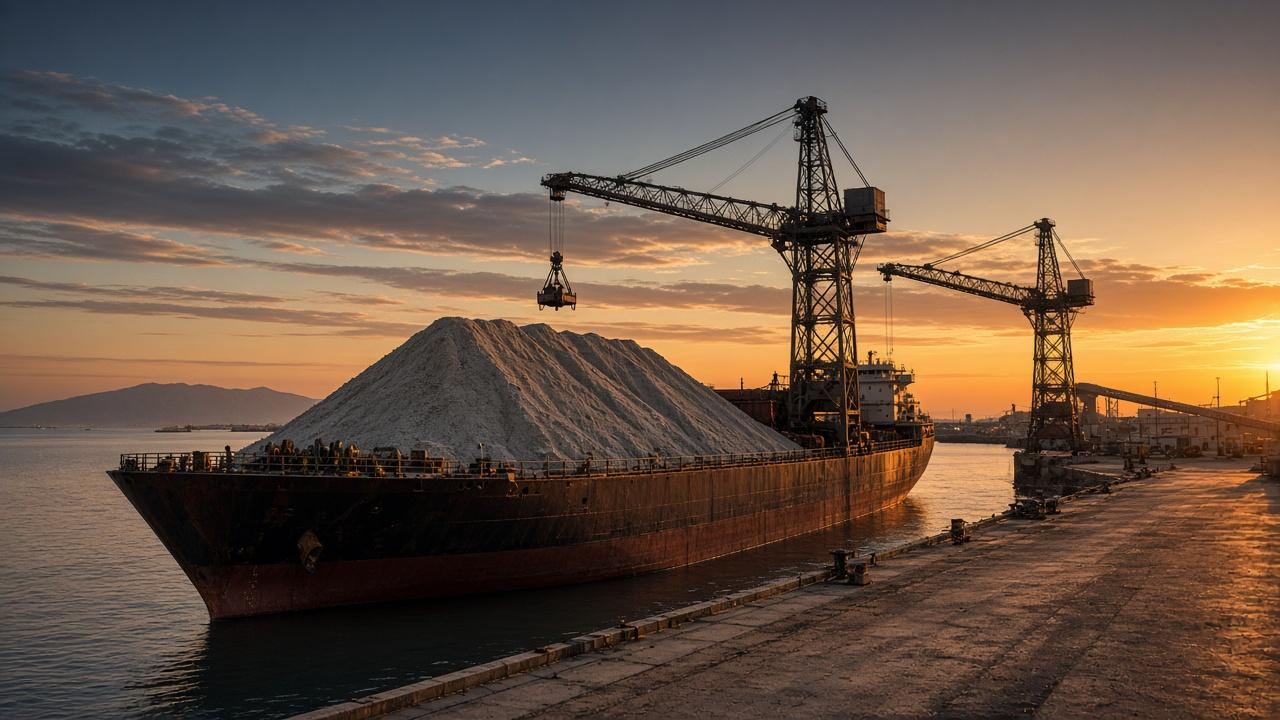
Name the form before you name a port. If the works slakes on site, the cargo is quicklime. If the works doses a hydroxide that has already been slaked, the cargo is hydrated lime. Quicklime vs hydrated lime is not a packing choice and not a grade tucked inside one product. Quicklime is calcium oxide, produced by calcining limestone. Hydrated lime is calcium hydroxide, produced by slaking that oxide with water. Bins, holds, safety papers and the price per tonne all follow the form. A line that says only "lime" is not an offer you can put next to another line.
The rest of this note is how a buyer separates the two, which numbers to ask for, and which uses punish a mix-up. Cargo size, bags against bulk, and the moisture problems of a long voyage sit in bulk lime supply. The product we qualify is lime, and the form is the first field.
What buyers mean by lime
Procurement language is loose, and the looseness is where deals go wrong. "Burnt lime", "unslaked lime", "pebble lime", "lump lime" and "CaO" usually point at quicklime. "Hydrated lime", "slaked lime", "lime hydrate" and "calcium hydroxide" point at the product after water has been added. "Milk of lime" and "lime slurry" are not cargoes. They are suspensions made at the user's plant from one of the two solids. If a brief asks for milk of lime, ask whether the plant wants the oxide to slake itself or the hydroxide to disperse.
Fineness is not the form. Ground quicklime and hydrated lime can both look like a white powder. One still reacts with water and gives off heat. The other has already taken its chemical water. A sieve result does not tell you which one is in the bag. Size is the second line of the order.
High-calcium and dolomitic lime are a further cut. Dolomitic material carries a material share of magnesium. This page stays with high-calcium quicklime and high-calcium hydrate. An uncalcined calcium-magnesium carbonate is not this product. Say so before anyone prices a hold.
In French correspondence the single word chaux is often used for both forms. An offer that stops there has not chosen a product. Reply with the form you dose, not with a synonym.
Available lime belongs in this vocabulary as a question, not as a published figure. It is the share of the shipment that will actually do the chemical work, measured by the method your plant or your standard names. Two lots can both be called quicklime and carry very different available lime. We do not print a standing percentage. We confirm the figure on the qualified lot, by the method the contract names.
The decision
Decide the form from the equipment and the reaction, then check whether a qualified lot can meet it. The cheaper quote is a later question, and only after both offers are the same form.
A site with a slaker, water sized for it, steam and dust exhaust, and people who handle a reactive oxide is a quicklime site. A dry feeder, a slurry tank or a bag dump with no slaker is a hydrate site. Putting the other form in is a shutdown and often a permit job. It is not a line on a bid comparison.
Slaking leaves water in the solid as hydroxide. A tonne of hydrate therefore carries less calcium, on a pure chemistry basis, than a tonne of the oxide it came from. Real cargoes are not pure, so there is no catalogue factor to apply. Convert inside the rule your specification already uses, and only once each lot has an available-lime result. Until then a lower price per tonne is a different chemical in a different weight.
Slaking also releases heat. Plants that want that heat in a soil job, or that already manage it in a slaker, buy quicklime. Plants that cannot take that heat in a silo, a tanker or a small dosing room buy hydrate. A wet hold on quicklime is not a minor complaint. Water is a reagent.
Reactivity is how fast quicklime slakes under a stated test: sample mass, water mass, start temperature, and time to a temperature the method defines. A steel shop and a soil contractor do not want the same speed. Hydrate has no curve of that kind. Its physical check is a fineness or a sieve residue, sometimes a surface behaviour in a gas or water duty. A request for a quicklime reactivity time on a hydrate offer means two products are still in the brief.
Send the decision as one sentence: form, size or fineness, the test you will accept, how you unload, the tonnes and the port. A later switch needs a new specification, new packing, new safety documents if the destination asks, and often a new lot. We re-qualify. We do not turn a quicklime confirmation into hydrate by email.
Specifications
Ask for the parameters your process can police. Leave the rest off the purchase order. A long sheet that nobody at discharge will test is how disputes start.
For quicklime the usual set is available lime as calcium oxide, residual carbon dioxide or loss on ignition, a size, free moisture, and a reactivity result if the plant slakes against the clock. Residual carbon dioxide is stone the kiln did not finish. Free moisture is oxide that has already started to slake in the shed. Both steal available oxide, and they are different failures. Name the reactivity method, or attach the page of the standard, including sample mass and water mass.
For hydrated lime the usual set is available lime as hydroxide or as oxide-equivalent, written the way your standard writes it, plus free moisture, a sieve residue, and insoluble matter only if you will reject on it. Free moisture here is water that is not the water of hydration. A complete hydrate can still arrive caked after damp air and carbon dioxide have worked on a silo. Insoluble matter becomes sludge in a water plant and is often irrelevant in a soil mix. Put it on the sheet only when the plant cares.
Magnesium, sulfur, silica or iron belong on the sheet only when you have a ceiling. Send the element, the unit and the test. A multi-element certificate is not a specification unless you mark the lines you will reject on.
Size needs words a sampler can check. Lump, pebble, granular and pulverised are not the same cut. Give a top size and a bottom size, or a residue on a named sieve. A laser curve is a different request. Say so before the vessel is fixed.
Calcining, for the buyer, is heating limestone until the carbonate breaks down and carbon dioxide leaves. What remains is mostly calcium oxide, plus unfinished stone and whatever in the rock was not calcium carbonate. Kiln type and fuel stay with the producer. Your levers are residual carbon dioxide, available lime and size on the lot offered.
Slaking is the controlled addition of water to quicklime to make the hydroxide. Done at the producer's plant, you ship hydrate, milled and screened. Done at your plant, you ship quicklime and you own the slaker, the steam and the grit. Same family of reaction. Different commercial object.
We share figures for the qualified lot. A previous cargo's certificate is a reference for how that producer reports, not a promise for the next hold.
Uses and the wrong product
Steel shops are mostly quicklime buyers. The oxide is a flux. Size matters because bunkers, conveyors and injection systems plug or flush on the wrong cut. Reactivity matters because the lime has to work inside the time of the converter, the ladle or the sinter strand. Sulfur or phosphorus ceilings, where the shop has them, belong in that brief. Hydrate is the wrong product: it brings water of hydration into a process that wanted oxide, and it usually arrives as a powder the handling system was not built for. A shop can still buy two quicklimes, a fine cut for injection and a coarser cut for another step. Those are two orders. "Lime for steel" with no size and no form goes back.
Construction follows the method statement. Soil work that dries the ground and reacts with clay is often quicklime. The heat and the appetite for water are the point. Soil work specified as hydrate is a different method, used where that heat is unwelcome or the moisture must not drop too fast. Mortars, plasters and many dry-mix plants specify hydrate, with a fineness and sometimes a residue. Quicklime into a dry-mix line with no slaker is a safety incident. Hydrate into a quicklime soil specification fails the method even though calcium is present. Quote the statement. Do not translate the word lime on a drawing into whatever is in a shed.
Water plants follow the dosing gear. A slaker and a grit separator mean quicklime made into slurry on site. A bag tip or powder blown into a tank means hydrate. Plants that pay to haul sludge often cap insoluble matter. Available lime sets the dose: a weaker lot changes the mass required for the same pH or the same softening result. Do not invent a dose from the product name.
Flue-gas and some other gas duties ask for a hydrate with a fineness, and sometimes a surface behaviour a construction hydrate was never sold against. Say what you will test. If that test sits outside a bulk hydrate lot, this supply is the wrong product and the inquiry stops or moves.
Neutralisation and duties such as paper or sugar can accept only the form and the impurity list the plant already runs. Send that list. The wrong product is the form the equipment cannot feed, the form the specification does not name, or the form whose certificate answers a different test from the one your lab will run. Price is not on that list.
Packing and cargo
Form decides the hold. Quicklime in bulk needs dry steel, sound hatches and a loading window that does not leave the cargo in rain. Hydrate in bulk is a powder: dust at the spout, a different flow in the hold, and a receiver who can unload powder rather than rock. Both move in bags or big bags when there is no bulk intake, and both then depend on how those bags were kept before the quay.
Free moisture on quicklime starts slaking in the pile. The surface can be partly hydroxide while the core is still oxide, so a top grab lies, and a wetted pocket can heat. That is why a casual stockpile stays unqualified until it is sampled as a cargo. Hydrate does not slake again. It carbonates and cakes. A big bag left in damp air can discharge as lumps a feeder will refuse, even when available lime was acceptable on the day of packing.
Say how you unload: grab, pneumatic, screw, bag dump, or big bag over a hopper. Powder offered to a grab crew that expected pebble fails at the berth with the chemistry still in specification. Previous cargo matters more than it does for an inert stone. A wet last cargo, an acidic residue, or a hold washed and not dried is a reason to refuse the ship or to line it. Who inspects, and to which standard, sits in the contract beside the product. Parcel and vessel size are in bulk lime supply. Do not fix the form after the ship is on subjects.
Bags need marks and a unit weight. Big bags need a discharge method and a working load the stevedore will accept. Neither removes the dry warehouse at both ends.
Documents, inspection and Incoterms
The certificate of analysis names the form, the lot, the date, the laboratory and the methods. Available lime without a method is a label. A reactivity time without the water ratio and the start temperature is a label. State the basis, dry or as-received. Mixing the two invents a shortage.
Lime moves in bad storage, so a sample taken weeks earlier from another pile is not the cargo. Build a composite during loading, from increments across the parcel, and keep a sealed reserve. A single grab from a hatch corner is how arguments start. Name who samples, how many increments, and how long the reserve is held. After the ship sails, that reserve is the sample both sides can still share.
Appoint an inspector when the parcel is large or the receiver will test on arrival. The inspector applies the contract: hold condition, sampling, bag seals if any, and weight by draft survey or weighbridge. The draft survey is a weight. It says nothing about available lime. Keep the two documents apart.
Safety papers are issued when the destination asks. The oxide reacts with water and gives off heat. The hydroxide is an irritant powder that has already taken that water. If the importer, the carrier or the port wants a safety data sheet and the proper shipping name, that request is part of the offer, for the form actually shipped.
We work with FOB, CFR, CIF and, for bags or containers, FCA. FOB means loaded on board at the Algerian load port, with freight, insurance and discharge on you. CFR means we arrange freight to the named port and insurance stays with you. CIF adds insurance at the level the contract states. FCA hands the goods to your carrier at an agreed point. Risk follows the term you sign. If it passes at loading, your cover has to deal with rain after that, hatches included. A hold survey while the ship can still be rejected is the useful one. The export set beside the analysis is the invoice, the bill of lading, a certificate of origin from the competent chamber, and a weight certificate. Packing lists apply to bags. None of them repairs a contract that names the wrong form.
Algerian qualification
Qualification is a match between your brief and a lot that can be exported as that form, through a port that can load it, to a receiver who can take it. It is not a claim that every kiln makes both products, and it is not a page of standing assays.
We start from the form and the tests you named. Ground quicklime does not stand in for hydrate. A coarse pebble does not stand in for a powder you inject. Gaps are raised before a price is treated as firm, whether the gap is the product or a document the destination wants and the producer has not issued before. You hear that before laycan.
Export from Algeria runs through a registered exporter, with banking domiciliation of the proceeds and a customs declaration at the load port. Payment terms are therefore discussed with the Incoterm. Where a mineral needs a sector authorisation, we check it on the grade in front of us before we quote. We do not publish a list of plants, and we do not borrow another cargo's analysis.
The load port is fixed when the lot, the packing and the vessel fit. Screening of the buyer, the receiver, the vessel and the destination sits in the same work. The sequence is on the supply and export process page.
What to send
Send one form. Quicklime or hydrated lime. Then the size or the sieve residue. Then any available-lime window, reactivity method, residual carbon dioxide, free moisture or impurity ceiling you actually enforce. Then volume, destination port or delivery point, how you unload, the delivery window, and the Incoterm you want to discuss.
Add whether you slake on site. Add the standard or method statement if a lab will test against it. A previous certificate is a picture of what you are used to reading. It becomes a specification only when you mark the mandatory lines.
Use the trade inquiry and pick lime. We reply with what is confirmable on a lot and what is not.
Can hydrated lime replace quicklime when the quote is lower?
Only if the plant was already able to use hydrate. The lower number is a price for a heavier chemical, often finer, with a different safety sheet and a different unloading method. Convert on the available-lime basis in your own specification, after a lot analysis exists for both, and add the cost of any change at the plant. No slaker, with the paperwork still saying quicklime: the hydrate quote matches the plant, and the quicklime quote is a project. A slaker and a duty written for oxide: set the hydrate quote aside.
What is available lime if you do not publish a percentage?
It is the result of a defined test for the useful oxide or hydroxide in a sample. Different methods and different reporting bases (oxide, hydroxide, dry, as-received) do not produce comparable figures. We ask which method you use, we run or obtain that method on the lot being offered, and the contract cites the result and the method together. A brochure value, or a value from a cargo shipped to someone else, is not your number. If your plant has no method of its own, say which standard your lab can reproduce. Picking the method is part of writing the order.
Will quicklime slake itself on a long voyage?
It will take moisture and carbon dioxide from air, and it will slake where liquid water reaches it. A sound, dry hold on a normal voyage is a managed risk, not a transformation into hydrate. A leak, a wet previous cargo, open hatches in rain, or heavy condensation is a different voyage. Hold inspection and the sampling point belong in the contract. An arrival sample taken after the receiver has wetted a hopper is poor evidence of what was loaded.
Is ground quicklime the same order as pebble quicklime?
No. Both are quicklime, and they still behave as different materials in a bunker, a slaker and a hold. Pebble and lump carry a size range you should write as top size and fines. Ground quicklime raises dust, flows differently, and often comes with a residue or a particle-size request. Reactivity can also differ because finer oxide meets water faster. If your slaker or your injector was tuned on one size, name that size. An offer that says "quicklime, size to be agreed" is not ready to fix a ship.
Which form should a water plant name?
Name the form that matches the dosing equipment you have this year. Slaker and grit removal: quicklime, with available lime, size and the insoluble limit if sludge is a cost for you. Bag tip, silo and slurry tank: hydrated lime, with available lime on the basis your dose calculation uses, free moisture and sieve residue. If you are building a slaker and want oxide later, keep that as a second inquiry. Do not buy hydrate now under a contract written so loosely that someone can deliver oxide into a bag store.
Why is a change of form a new deal rather than a variation?
Because the product, the test list, the hazard, the weight basis and often the producer lot all change. A variation clause is for a quantity tolerance or a laycan shift inside one commodity. It is not a device for turning oxide into hydroxide after the buyer has sold the cargo onward or after the receiver has set a silo. If you need both forms in one programme, open two lines, each with its own specification and its own release. We will not confirm a single "lime" contract and decide the form at the berth.